The USA is on the brink of defaulting on the $14.7 trillion it now owns. The potential impact of such an event are almost impossible to imagine. But one very clear effect of downgrading the USA's current triple A rating would be an increase in the interest rates it would have to pay on any further loans - and as Greece knows only too well, this can easily double the amount of outstanding debt in just a year or too. Surely, noone in their right mind could imagine that this sort of situation can be solved by simply cutting public expenditure? The British Chancellor appears to think that cutting back on public spending is all that is needed. I'm convinced that they are all wrong.
What is needed is a taxation system that gets revenue from the unproductive parts of the economy - namely, the trillions of dollars, euros and pounds that are being used for speculation. Without any need for a specific tax on speculation, it would be enough to impose a flat rate financial transaction tax on all transactions to have the desired effect. I can think of no logical argument that could defend the idea that speculation should be untaxed whereas the useful stuff like buying goods and services should be taxed with 20% VAT.
26 Jul 2011


30 Jun 2011
EU moves to introduce transaction taxes
With the disastrous situation in Greece and today's public sector strikes in the UK, it seems to me that the EU's proposals for introducing financial transaction taxes are a particularly interesting development. There are articles in the Guardian both today and yesterday about the EUs proposal to use a bank transaction tax to raise revenue.
Of course, the UK government immediately moved to block such moves. Why? If this sort of mechanism was in place, the Greek debt crises would be relatively easy to fix, without having to go borrowing yet more money from the markets and getting tax payers even more in debt. But of course, the UK government is being paid by the City to protect their interests even when the vast majority of the public are suffering as a result.
Of course, the UK government immediately moved to block such moves. Why? If this sort of mechanism was in place, the Greek debt crises would be relatively easy to fix, without having to go borrowing yet more money from the markets and getting tax payers even more in debt. But of course, the UK government is being paid by the City to protect their interests even when the vast majority of the public are suffering as a result.
5 Jun 2011
Osborne plan isn’t working, say top UK economists
Front page of this morning's Observer. Yes, amazingly, there are economists who doubt that the solution to the massive national debt in the UK is to cripple the economy.
I posted a comment on the Obsever's site about my propositions for a plan B in which I also gave a plug to the positive money site's analysis of fractional reserve banking and its perils.
I wonder if anyone will pick up on this....
I posted a comment on the Obsever's site about my propositions for a plan B in which I also gave a plug to the positive money site's analysis of fractional reserve banking and its perils.
I wonder if anyone will pick up on this....
22 May 2011
The Positive Money initiative
Sorry - I've been totally overloaded for the last month and haven't been able to work on my blog, despite the fact that there is plenty to talk about.
But I've been spurred into action by a mail from my sister (Thanks Caroline!) pointing me to site called Postive Money that argues that some of the most important problems that we face are the result of fractional reserve banking - the system that effectively allows banks to create money out of thin air by lending.
They have a series of videos that explain the basic features of our current banking system that are really clear. I've signed up...
But I've been spurred into action by a mail from my sister (Thanks Caroline!) pointing me to site called Postive Money that argues that some of the most important problems that we face are the result of fractional reserve banking - the system that effectively allows banks to create money out of thin air by lending.
They have a series of videos that explain the basic features of our current banking system that are really clear. I've signed up...
16 Apr 2011
1000 experts call for a Robin Hood Tax
I've been a bit quiet for the last couple of weeks - handling over 730 submissions for the European Conference on Visual Perception that I'm organising at the end of August. But that doesn't mean that there haven't been imporant things going on.
For example, thursday's Guardian had a thing on the front page about the fact that 1000 economists from 53 countries have written to the leaders of the G20 calling them to impose a 0.05% Robin Hood tax on financial transactions to finance third world development.
Here's what they say:
Dear G20 Finance Ministers and Bill Gates,
We write to you as the call for a Financial Transaction Tax is now gathering global momentum, and the French government has made it a key priority for their G20 presidency.
This tax is an idea that has come of age. The financial crisis has shown us the dangers of unregulated finance, and the link between the financial sector and society has been broken. It is time to fix this link and for the financial sector to give something back to society.
Even at very low rates of 0.05% or less, this tax could raise hundreds of billions of dollars annually and calm excessive speculation. The UK already levies a tax on share transactions of 0.5%, or ten times this rate, without unduly impacting on the competitiveness of the City of London.
This money is urgently needed to raise revenue for global and domestic public goods such as health, education and water, and to tackle the challenge of climate change.
Given the automation of payments, this tax is technically feasible. It is morally right.
We call on you to implement the FTT as a matter of urgency.
Yours.
All good sense.
The Guardian article also points to an Oxfam poll that shows that 51% of people in the UK support the idea of a Robin Hood tax. The poll also showed that 19% of people were actually opposed to the idea. Who are these people? To me it seems demonstrates the power of the financial lobbies that there can be any sane people that would oppose the idea. All members of the public are currently being charged by the banks for every financial transaction - 3% or more to use a credit card and often 2% or even a flat rate fee for drawing out cash from a cash dispenser. Why on earth should banks get away with charging us al transaction fees when they don't pay anything to speculate with trillions of dollars of transactions every day??
For example, thursday's Guardian had a thing on the front page about the fact that 1000 economists from 53 countries have written to the leaders of the G20 calling them to impose a 0.05% Robin Hood tax on financial transactions to finance third world development.
Here's what they say:
Dear G20 Finance Ministers and Bill Gates,
We write to you as the call for a Financial Transaction Tax is now gathering global momentum, and the French government has made it a key priority for their G20 presidency.
This tax is an idea that has come of age. The financial crisis has shown us the dangers of unregulated finance, and the link between the financial sector and society has been broken. It is time to fix this link and for the financial sector to give something back to society.
Even at very low rates of 0.05% or less, this tax could raise hundreds of billions of dollars annually and calm excessive speculation. The UK already levies a tax on share transactions of 0.5%, or ten times this rate, without unduly impacting on the competitiveness of the City of London.
This money is urgently needed to raise revenue for global and domestic public goods such as health, education and water, and to tackle the challenge of climate change.
Given the automation of payments, this tax is technically feasible. It is morally right.
We call on you to implement the FTT as a matter of urgency.
Yours.
All good sense.
The Guardian article also points to an Oxfam poll that shows that 51% of people in the UK support the idea of a Robin Hood tax. The poll also showed that 19% of people were actually opposed to the idea. Who are these people? To me it seems demonstrates the power of the financial lobbies that there can be any sane people that would oppose the idea. All members of the public are currently being charged by the banks for every financial transaction - 3% or more to use a credit card and often 2% or even a flat rate fee for drawing out cash from a cash dispenser. Why on earth should banks get away with charging us al transaction fees when they don't pay anything to speculate with trillions of dollars of transactions every day??
28 Mar 2011
Feedback on Plan B....
Well, it's now a week since I sent my proposition to the Guardian. No news yet...
I've had some feedback though. First, I had a comment from Matt Usselman who wished me luck, but bet me a beer that I would never get it published. He has been trying for months to get an article that he wrote on the danger of Credit Default Swaps published - with no success. He's tried the Guardian, the BBC, ZEIT and die Sueddeutsche Zeitung (in German) amongst others. He's now pretty convinced that this sort of stuff is getting blocked. For info, his article is about the fact that Hedge Funds have taken out some 4 billion euros worth of Credit Defaults Swaps that are effectively betting that the Irish government will default on their payments. And if (when?) they do, taxpayers will need to bail out the banks who took on these bets and will have to find something like 54 billion euros to pay them off.
The other bit of feedback was from my son Jonathan (hi Jonathan!) who, despite being fundamentally pro-FTT, thinks that I'm undermining my case by suggesting that large amounts of money can be generated this way. He suggests that I should use the numbers that Stephan Schulmeister uses in a paper that I mentioned a few months ago, called "A General Financial Transaction Tax: A Short Cut of the Pros, the Cons and a Proposal". Schulmeister tries to make some predictions about the effect of introducing an FTT on financial transactions themselves, and assumes (arbitrarilly, it seems) that a 0.01% FTT would reduce transactions by 25%, a 0.05% FTT would reduce transactions by 65%, and a 0.1% FTT would reduce transactions by 75%.
The implication is that with an even larger FTT (up to 1%, as I would propose), that everything might grind to a halt. But my point is that the only things that would grind to a halt would be the transactions that have no real function - like currency speculation. As I mentioned in my "Plan B" posting last week, the BIS report states that "the value of Credit transfers, Direct Debits, Card payments and Cheques in the UK totalled £70.4 trillion". That looks like the real economy at work - not the speculators. And a 1% tax on that really would generate more revenue than all the current taxation systems put together. That means that any extra revenue that can be generated before the speculation stops (which I hope I will) is all good news for the taxpayers.
For me, it is clear that we need to raise revenue from taxes, but that we can choose how we do it. I think that rather than seeing FTTs as a way to punish the banks, I think that the even more positive way to think about it would be to see it as a way to get rid of the current completely outdated systems of taxation. Getting rid of taxes on profits (corporation tax), pay (income tax), employment (national insurance contributions), and sales (via excessive VAT), and replacing them all by a simple, streamlined, easy to implement generalized FTT seems to make so much sense to me.
As it happens, we are also looking at a way to recover the £1.5 trillion that the UK taxpayer has provided to the banks. That won't happen just by cutting back on public spending. A generalized FTT at around 1% on all transactions might well lead to speculative trading either collapsing or moving offshore - and clearly it won't generate 100 times total GDP. But in the six months or so that it would take the financial markets to move elsewhere (or to start doing more intelligent with the money they have), the cost of the bank bailout could be recovered. And the UK taxpayers would no longer be paying £10 billion a month in interest to the banks that they currently have to pay because they have lent money to the banks (yes, it does sound insane).
I've had some feedback though. First, I had a comment from Matt Usselman who wished me luck, but bet me a beer that I would never get it published. He has been trying for months to get an article that he wrote on the danger of Credit Default Swaps published - with no success. He's tried the Guardian, the BBC, ZEIT and die Sueddeutsche Zeitung (in German) amongst others. He's now pretty convinced that this sort of stuff is getting blocked. For info, his article is about the fact that Hedge Funds have taken out some 4 billion euros worth of Credit Defaults Swaps that are effectively betting that the Irish government will default on their payments. And if (when?) they do, taxpayers will need to bail out the banks who took on these bets and will have to find something like 54 billion euros to pay them off.
The other bit of feedback was from my son Jonathan (hi Jonathan!) who, despite being fundamentally pro-FTT, thinks that I'm undermining my case by suggesting that large amounts of money can be generated this way. He suggests that I should use the numbers that Stephan Schulmeister uses in a paper that I mentioned a few months ago, called "A General Financial Transaction Tax: A Short Cut of the Pros, the Cons and a Proposal". Schulmeister tries to make some predictions about the effect of introducing an FTT on financial transactions themselves, and assumes (arbitrarilly, it seems) that a 0.01% FTT would reduce transactions by 25%, a 0.05% FTT would reduce transactions by 65%, and a 0.1% FTT would reduce transactions by 75%.
The implication is that with an even larger FTT (up to 1%, as I would propose), that everything might grind to a halt. But my point is that the only things that would grind to a halt would be the transactions that have no real function - like currency speculation. As I mentioned in my "Plan B" posting last week, the BIS report states that "the value of Credit transfers, Direct Debits, Card payments and Cheques in the UK totalled £70.4 trillion". That looks like the real economy at work - not the speculators. And a 1% tax on that really would generate more revenue than all the current taxation systems put together. That means that any extra revenue that can be generated before the speculation stops (which I hope I will) is all good news for the taxpayers.
For me, it is clear that we need to raise revenue from taxes, but that we can choose how we do it. I think that rather than seeing FTTs as a way to punish the banks, I think that the even more positive way to think about it would be to see it as a way to get rid of the current completely outdated systems of taxation. Getting rid of taxes on profits (corporation tax), pay (income tax), employment (national insurance contributions), and sales (via excessive VAT), and replacing them all by a simple, streamlined, easy to implement generalized FTT seems to make so much sense to me.
As it happens, we are also looking at a way to recover the £1.5 trillion that the UK taxpayer has provided to the banks. That won't happen just by cutting back on public spending. A generalized FTT at around 1% on all transactions might well lead to speculative trading either collapsing or moving offshore - and clearly it won't generate 100 times total GDP. But in the six months or so that it would take the financial markets to move elsewhere (or to start doing more intelligent with the money they have), the cost of the bank bailout could be recovered. And the UK taxpayers would no longer be paying £10 billion a month in interest to the banks that they currently have to pay because they have lent money to the banks (yes, it does sound insane).
20 Mar 2011
Time to push for Plan B
I've just written a document that I hope to be able to get published in a newspaper like the Guardian. It's called "Here is Plan B". I'm including it here in the hope that I might get some feedback that will help improve the argumentation. Please feel free to comment!
Here is Plan B
According to the latest figures from the Office for National Statistics, the UK's National Debt now stands at £867 billion - £2,244 billion if you include the cost of the bank bailouts. The coalition government claims that the only way to get the country out of this mess is by imposing drastic cuts across the board, and the results are for all to see. Education, research, health, pensions, public sector pay, libraries, social services, and even policing and defence are all being hit with a ferocity that beggars belief. We are constantly being told that there is no alternative, that there is no plan B.
Yes there is. Introducing a flat rate Financial Transaction Tax (FTT) on all financial transactions, even at modest levels well below 1%, would generate such colossal amounts of revenue that the national debt could be wiped out within months and public spending programs restored. Even more remarkably, the revenues would be so high that it would be perfectly feasible to drastically reduce or even abolish the main current forms of taxation, namely income tax, national insurance contributions, VAT and corporation tax, providing a massive and much needed boost to the economy.
This may seem incredible, but it is true. While it is impossible to compile the complete figures (the financial sector has got used to being allowed to get away with levels of secrecy that are quite unjustified), the Bank for International Settlements (BIS) provides hard numbers for a range of transactions. For example, in December 2010, BIS published data for financial activity in the 21 countries covered by the Committee on Payment and Settlement Systems for 2009. The report shows that in the UK, the value of Credit transfers, Direct Debits, Card payments and Cheques in the UK totalled £70.4 trillion. And payments processed by selected interbank fund transfer systems such as CHAPS (Clearing House Automated Payment System) and BACS (Banker's Automated Clearing Services) were over £64 trillion. But the really big numbers come from the value of contracts and transactions cleared by LCH.Clearnet Ltd (£588.8 trillion) and delivery instructions handled by the CREST system (£178.2 trillion). Together, these numbers add up to over £900 trillion. In case you're wondering, a trillion is a one with twelve zeros after it - meaning that we are talking about £900 000 000 000 000 in a single year - a figure more than 1700 times total tax revenue, currently £530 billion per year , and roughly 670 times UK GDP, currently £1.35 trillion.
Note that this £900 trillion number is probably way below the current values because it refers to trading in the year following the meltdown in the financial markets in 2008. The BIS totals for the UK in 2007 and 2008 were both well over £1000 trillion, and with the recent boom in the financial markets (demonstrated by the recent announcements of massive profits within the banking sector) it seems inevitable that the next set of numbers will be sky-rocketing again.
Amazingly, even these eye-watering numbers must clearly be massive underestimates. For example, the BIS figures don't even include trading on the London Stock Exchange (which, for your information, totalled over £1.3 trillion last year) – the numbers have been "nav" (not available) since 2005. Nor do they include the value of securities and derivatives trading handled by the Virt-x system (which has recently been taken over by the Swiss Exchange system). But even more significantly, the figures provided by the BIS fail to include the vast amounts of trading that involve what they call "other financial institutions" – these include "financial institutions not classified as reporting dealers, such as non-reporting banks, hedge funds, pension funds, mutual funds, insurance companies and central banks, among others". It is difficult to get firm numbers for these transactions, but every three years, the BIS compiles a report based on more complete figures obtained during just one month. The Bank of England provided information for the month of April 2010 that was included in the latest BIS triennial report published last December. According to the Bank of England's data, "net average daily turnover during April 2010 in the UK foreign exchange market was $1,854 billion per day". Assuming roughly 250 trading days per year, this implies that the UK is responsible for something like £285 trillion in foreign exchange trading per year (some 37% of the global total, according to the BIS report). The other figure provided by the Bank of England for activity during April 2010 concerned the global interest rate OTC (over the counter) derivatives market, which was running at $1,235 billion a day. This adds up to a further £190 trillion per year – a whopping 46% of the global total.
And even these mind-boggling figures are quite possibly only scratching the surface. Firstly, even the Bank of England's website noted that only 47 UK institutions participated in the UK survey, down from 93 in 2004 and 62 in 2007, "as only firms that participate in the inter-dealer market and/or have a large active derivative business with customers were asked to complete the 2010 survey. Small institutions were not asked to participate in order to reducing their reporting burden". Who is to say what levels of activity are being hidden here?
Secondly, what about all the speculation on the commodities markets, trading that has almost certainly contributed directly to the massive increases and instability in food prices and raw material costs over recent years? What are the numbers here? Of course, the financial industry is in no rush to provide these figures. And there is little doubt that much of the trading is hidden by the maze of both off-shore and on-shore tax-havens that the financial industry has succeeded in creating in places like the Channel Islands and the Caymans – well out of sight of nosy regulatory authorities like the BIS.
Can there be any doubt that, every year, financial transactions within the UK are thousands of times higher than the total national debt, and thousands of times larger than all the revenue generated by all existing taxes? The implication is clear. Even a very modest 0.1% financial transaction tax would allow the debt to be wiped out in just a year, and could allow all existing taxes to be either abolished or at least drastically reduced. So, why doesn't the UK government impose such a measure?
One reason may be that much of the Conservative party's funding comes from precisely the people who are responsible for the hyperactivity in the financial markets, and no doubt they have a vested interest in keeping the system as it is. After all, it is probably this intense activity on the foreign exchange and derivatives markets that allow the banks to maintain profits and bonuses at such astronomical levels. Is it conceivable that the government might not be acting in the best interests of the British public, but rather defending the interests of the City?
No doubt the City will protest that any tax on transactions will cripple the economy, and that any attempt to impose even the tiniest tax on the thousands of trillions of pounds of transactions in the UK Financial sector would simply result in the traders moving elsewhere. But the UK has been imposing a 0.5% transaction tax on share trading since 1986, a tax that generates several billions in revenue per year. Is there any evidence that this has crippled the London Stock Exchange? If the London Stock Exchange can continue to function with a 0.5% tax, why should other transactions be exempt? Is the financial activity that depends on currency speculation or the global interest rate derivatives market somehow more "useful" than other areas of financial activity? Is it, for example, more useful to the economy than consumer spending, currently being hammered by both income tax and VAT at 20%? There can be no moral justification for having one rule for people living in the real world, and another for the speculators.
The government's position appears to be that while some sort of financial transaction tax could be an option, any such move would have to be implemented at a global level. And yet, when on the 8th of March, there was a vote in the European Parliament on a proposition to introduce Financial Transaction Taxes throughout the European community, two thirds of the British MEPs (including all the Conservative MEPs and nearly all the Liberal MEPs) voted against. Fortunately, support from other countries and in particular France and Germany was high (indeed both Nicolas Sarkozy and Angela Merkel are in favour), and as a result, the proposition was carried by 360 votes to 299. But I would not be surprised if many in the UK are unaware of this, because coverage in the British press was almost non-existent. Even the Guardian hardly even mentioned it.
Conservative MEP Vicky Ford can be seen on a BBC news report saying that a financial transaction tax would be like the 50p that you get charged for using a cash dispenser. In a sense, it's true. But unlike those fees, which go to the banks, the 50p FTT charge would go to pay off the national debt. We are all used to paying 2-3% more to be able to use a credit card. Surely, we would all be more than happy to accept a 1% charge if we knew that it was going to a good cause. More importantly, while each citizen would be paying a modest percentage each time they make a financial transaction, the traders and speculators would be paying the same percentage each time they make a transaction too. And since they are making millions more transactions that ordinary citizens, they would end up paying proportionately far more. That sounds fair to me.
There is a real chance that the UK government will attempt to block European moves to introduce Financial Transaction Taxes. And yet, a radical reform of taxation based on a flat rate FTT of say 1% would not only allow the UK to eliminate national debt "at a stroke". It would allow virtually all the current taxation schemes to be replaced by a single tax, that would be fair, cheap to implement, extremely difficult to avoid, and would ensure that those who contribute most will be those that are best able to afford it. Furthermore, the possibility of effectively abolishing both income tax and taxes on profits must surely be something that should appeal to any one interested in getting the UK economy back on track. Imagine how attractive the UK would be for industrial investment if it were a country where taxes on income and profits were zero.
Who could possibly oppose the idea of paying just 1% to the government when your salary arrives on your bank account, and a further 1% when you spend the money? Virtually everyone would be better off, including those who are currently paying no income tax at all, because VAT could be reduced dramatically or even abolished. The business sector will also be in favour, because they would be able to keep all their profits, and use the money to pay their employees bonuses, pay dividends to share-holders and invest for the future. Indeed, by eliminating taxation on profits, it would be possible to make tax havens effectively irrelevant. Why hide money in the Caymans if you can use it in the UK with only a minor transaction tax to pay? Only one group would be complaining – those in the financial sector who are currently siphoning money out of the system by speculation. Should the coalition government be allowed to protect these people while forcing the public to pick up the tab for the bank bailout? It is time for plan B.
Here is Plan B
According to the latest figures from the Office for National Statistics, the UK's National Debt now stands at £867 billion - £2,244 billion if you include the cost of the bank bailouts. The coalition government claims that the only way to get the country out of this mess is by imposing drastic cuts across the board, and the results are for all to see. Education, research, health, pensions, public sector pay, libraries, social services, and even policing and defence are all being hit with a ferocity that beggars belief. We are constantly being told that there is no alternative, that there is no plan B.
Yes there is. Introducing a flat rate Financial Transaction Tax (FTT) on all financial transactions, even at modest levels well below 1%, would generate such colossal amounts of revenue that the national debt could be wiped out within months and public spending programs restored. Even more remarkably, the revenues would be so high that it would be perfectly feasible to drastically reduce or even abolish the main current forms of taxation, namely income tax, national insurance contributions, VAT and corporation tax, providing a massive and much needed boost to the economy.
This may seem incredible, but it is true. While it is impossible to compile the complete figures (the financial sector has got used to being allowed to get away with levels of secrecy that are quite unjustified), the Bank for International Settlements (BIS) provides hard numbers for a range of transactions. For example, in December 2010, BIS published data for financial activity in the 21 countries covered by the Committee on Payment and Settlement Systems for 2009. The report shows that in the UK, the value of Credit transfers, Direct Debits, Card payments and Cheques in the UK totalled £70.4 trillion. And payments processed by selected interbank fund transfer systems such as CHAPS (Clearing House Automated Payment System) and BACS (Banker's Automated Clearing Services) were over £64 trillion. But the really big numbers come from the value of contracts and transactions cleared by LCH.Clearnet Ltd (£588.8 trillion) and delivery instructions handled by the CREST system (£178.2 trillion). Together, these numbers add up to over £900 trillion. In case you're wondering, a trillion is a one with twelve zeros after it - meaning that we are talking about £900 000 000 000 000 in a single year - a figure more than 1700 times total tax revenue, currently £530 billion per year , and roughly 670 times UK GDP, currently £1.35 trillion.
Note that this £900 trillion number is probably way below the current values because it refers to trading in the year following the meltdown in the financial markets in 2008. The BIS totals for the UK in 2007 and 2008 were both well over £1000 trillion, and with the recent boom in the financial markets (demonstrated by the recent announcements of massive profits within the banking sector) it seems inevitable that the next set of numbers will be sky-rocketing again.
Amazingly, even these eye-watering numbers must clearly be massive underestimates. For example, the BIS figures don't even include trading on the London Stock Exchange (which, for your information, totalled over £1.3 trillion last year) – the numbers have been "nav" (not available) since 2005. Nor do they include the value of securities and derivatives trading handled by the Virt-x system (which has recently been taken over by the Swiss Exchange system). But even more significantly, the figures provided by the BIS fail to include the vast amounts of trading that involve what they call "other financial institutions" – these include "financial institutions not classified as reporting dealers, such as non-reporting banks, hedge funds, pension funds, mutual funds, insurance companies and central banks, among others". It is difficult to get firm numbers for these transactions, but every three years, the BIS compiles a report based on more complete figures obtained during just one month. The Bank of England provided information for the month of April 2010 that was included in the latest BIS triennial report published last December. According to the Bank of England's data, "net average daily turnover during April 2010 in the UK foreign exchange market was $1,854 billion per day". Assuming roughly 250 trading days per year, this implies that the UK is responsible for something like £285 trillion in foreign exchange trading per year (some 37% of the global total, according to the BIS report). The other figure provided by the Bank of England for activity during April 2010 concerned the global interest rate OTC (over the counter) derivatives market, which was running at $1,235 billion a day. This adds up to a further £190 trillion per year – a whopping 46% of the global total.
And even these mind-boggling figures are quite possibly only scratching the surface. Firstly, even the Bank of England's website noted that only 47 UK institutions participated in the UK survey, down from 93 in 2004 and 62 in 2007, "as only firms that participate in the inter-dealer market and/or have a large active derivative business with customers were asked to complete the 2010 survey. Small institutions were not asked to participate in order to reducing their reporting burden". Who is to say what levels of activity are being hidden here?
Secondly, what about all the speculation on the commodities markets, trading that has almost certainly contributed directly to the massive increases and instability in food prices and raw material costs over recent years? What are the numbers here? Of course, the financial industry is in no rush to provide these figures. And there is little doubt that much of the trading is hidden by the maze of both off-shore and on-shore tax-havens that the financial industry has succeeded in creating in places like the Channel Islands and the Caymans – well out of sight of nosy regulatory authorities like the BIS.
Can there be any doubt that, every year, financial transactions within the UK are thousands of times higher than the total national debt, and thousands of times larger than all the revenue generated by all existing taxes? The implication is clear. Even a very modest 0.1% financial transaction tax would allow the debt to be wiped out in just a year, and could allow all existing taxes to be either abolished or at least drastically reduced. So, why doesn't the UK government impose such a measure?
One reason may be that much of the Conservative party's funding comes from precisely the people who are responsible for the hyperactivity in the financial markets, and no doubt they have a vested interest in keeping the system as it is. After all, it is probably this intense activity on the foreign exchange and derivatives markets that allow the banks to maintain profits and bonuses at such astronomical levels. Is it conceivable that the government might not be acting in the best interests of the British public, but rather defending the interests of the City?
No doubt the City will protest that any tax on transactions will cripple the economy, and that any attempt to impose even the tiniest tax on the thousands of trillions of pounds of transactions in the UK Financial sector would simply result in the traders moving elsewhere. But the UK has been imposing a 0.5% transaction tax on share trading since 1986, a tax that generates several billions in revenue per year. Is there any evidence that this has crippled the London Stock Exchange? If the London Stock Exchange can continue to function with a 0.5% tax, why should other transactions be exempt? Is the financial activity that depends on currency speculation or the global interest rate derivatives market somehow more "useful" than other areas of financial activity? Is it, for example, more useful to the economy than consumer spending, currently being hammered by both income tax and VAT at 20%? There can be no moral justification for having one rule for people living in the real world, and another for the speculators.
The government's position appears to be that while some sort of financial transaction tax could be an option, any such move would have to be implemented at a global level. And yet, when on the 8th of March, there was a vote in the European Parliament on a proposition to introduce Financial Transaction Taxes throughout the European community, two thirds of the British MEPs (including all the Conservative MEPs and nearly all the Liberal MEPs) voted against. Fortunately, support from other countries and in particular France and Germany was high (indeed both Nicolas Sarkozy and Angela Merkel are in favour), and as a result, the proposition was carried by 360 votes to 299. But I would not be surprised if many in the UK are unaware of this, because coverage in the British press was almost non-existent. Even the Guardian hardly even mentioned it.
Conservative MEP Vicky Ford can be seen on a BBC news report saying that a financial transaction tax would be like the 50p that you get charged for using a cash dispenser. In a sense, it's true. But unlike those fees, which go to the banks, the 50p FTT charge would go to pay off the national debt. We are all used to paying 2-3% more to be able to use a credit card. Surely, we would all be more than happy to accept a 1% charge if we knew that it was going to a good cause. More importantly, while each citizen would be paying a modest percentage each time they make a financial transaction, the traders and speculators would be paying the same percentage each time they make a transaction too. And since they are making millions more transactions that ordinary citizens, they would end up paying proportionately far more. That sounds fair to me.
There is a real chance that the UK government will attempt to block European moves to introduce Financial Transaction Taxes. And yet, a radical reform of taxation based on a flat rate FTT of say 1% would not only allow the UK to eliminate national debt "at a stroke". It would allow virtually all the current taxation schemes to be replaced by a single tax, that would be fair, cheap to implement, extremely difficult to avoid, and would ensure that those who contribute most will be those that are best able to afford it. Furthermore, the possibility of effectively abolishing both income tax and taxes on profits must surely be something that should appeal to any one interested in getting the UK economy back on track. Imagine how attractive the UK would be for industrial investment if it were a country where taxes on income and profits were zero.
Who could possibly oppose the idea of paying just 1% to the government when your salary arrives on your bank account, and a further 1% when you spend the money? Virtually everyone would be better off, including those who are currently paying no income tax at all, because VAT could be reduced dramatically or even abolished. The business sector will also be in favour, because they would be able to keep all their profits, and use the money to pay their employees bonuses, pay dividends to share-holders and invest for the future. Indeed, by eliminating taxation on profits, it would be possible to make tax havens effectively irrelevant. Why hide money in the Caymans if you can use it in the UK with only a minor transaction tax to pay? Only one group would be complaining – those in the financial sector who are currently siphoning money out of the system by speculation. Should the coalition government be allowed to protect these people while forcing the public to pick up the tab for the bank bailout? It is time for plan B.
18 Mar 2011
An Alternative to VAT
As you probably know, I'm pushing to have all the main taxes (VAT, income tax and corporation tax) replaced by a single flat-rate Financial Transaction Tax. One major obstacle for this is the fact that the EU is largely financed by VAT, making it hard for individual countries to opt out.
Interestingly, I've just discovered that the EU is currently looking at the future of VAT, and there is a Green Paper called "Towards a simpler, more robust and efficient VAT system" and you can download the pdf here.
I also discovered that there is a period of consulation that started last december and runs until the end of May. The EU invites those affected by this initiative – all citizens, organisations, businesses, public authorities, tax practitioners, tax experts and academics - to provide their views on this matter. So, of course, I did. Here's the mail entitled "An Alternative to VAT" that I sent them yesterday. It would be great if they actually paid attention to it...
Value added taxes of the type used within the European Union are not only complex to implement - they also have additional disadvantages compared with a simple FTT based mechanism. When the production of a particular commodity involves a large number of different stages, VAT-based mechanisms mean that in the end the total amount of tax recovered does not change, irrespective of the number of production stages because at each stage, the producer can recover tax paid at earlier stage. The consumer will pay the basic rate of VAT, irrespective of the number of steps involved. In contrast, under the FTT based scheme, the 1% transaction fee will need to be paid at each step in the sequence, every time money is paid from one person to another. For foods that have a VAT rating of (say) 5%, the total amount of tax would only be more for an FTT based system if there were more that roughly 5 steps in the sequence. However, for many other goods, the effective VAT rate is often 20% or more. This means that the cost of the goods would often be lower using an FTT based system.
But there is another positive feature of the system. Imagine the effect for goods that are produced locally with very short supply chains. For example, consider a farmer who grows his own crops, grinds the wheat to produce his own flour, bakes his own bread and transports the goods to a local market using his own transportation. In that case, only the final purchase of the bread at the market would be subject to tax with the result that the effective tax rate would drop to just 1%.
This sort of price advantage for locally produced goods would greatly reduce the tendency of supermarkets to supply goods that are flown in from the other side of the world (with all the ecological consequences involved) simply because the current VAT based taxation system fails to penalise long supply chains."
Together, I believe that these various arguments make a strong case not just for reviewing the mechanisms used for collecting VAT, but for actually scrapping the whole thing.
I would be very interested to hear your reactions.
Yours sincerely,
Simon Thorpe
Senior Research Director with the CNRS
Interestingly, I've just discovered that the EU is currently looking at the future of VAT, and there is a Green Paper called "Towards a simpler, more robust and efficient VAT system" and you can download the pdf here.
I also discovered that there is a period of consulation that started last december and runs until the end of May. The EU invites those affected by this initiative – all citizens, organisations, businesses, public authorities, tax practitioners, tax experts and academics - to provide their views on this matter. So, of course, I did. Here's the mail entitled "An Alternative to VAT" that I sent them yesterday. It would be great if they actually paid attention to it...
Dear colleagues,
I read with interest that the EU is currently looking into ways of reforming the current VAT system.
I would like to draw your attention to a paper that I published in october 2010 that proposed that it would be possible to replace essentially all the current taxation methods (VAT, Income tax, Corporation tax) by a single flat rate Financial Transaction Tax.
The paper can be downloaded here and I have provided a good deal of updated information on my blog.
The basic idea is simple. Financial transactions within the countries covered by the Bank for International Settlements are running at around 1000 times the total tax revenue of the countries in question. A more recent set of figures that covered the period including the financial crisis in 2008 can be found here and shows that while this ratio dipped, it was still at least 729:1.
I have been unable to find full figures for the EU (maybe you know where they can be found), but it is worth pointing out that the numbers provided by the BIS are very clearly underestimates because of the very large numbers of transactions that are not covered. For example, according to the triannual BIS report (based on a single month of activity for which april 2010 was the last example, activity on the foreign exchanges was something like $4 trillion a day of which 37% was in the UK, together with a further $2.1 trillion per day of activity in the OTC global interest rate derivatives market (46% in the UK).
Imagine replacing all the current VAT mechanism with a single FTT at say 1%. This would give a tremendous boost to real economic activity within the EU, since effectively the only economic activity that would be discouraged would be speculation - including the currency speculation that has proved so damaging the the European Union.
In my paper, I pointed out a number of features of using financial transactions that I believe are significant advantages compared with conventional VAT-based mechanisms. In particular, I believe that collecting an FTT would be vastly less complex to implement than VAT - it would literally simply involve adding a line of code to the software used for handling financial transactions. Secondly, it would be far less easy to cheat - whereas the current arrangements for VAT have provided a wealth of opportunities for criminals to illegally obtain money from the EU by filing bogus VAT statements - I presume that I don't need to provide documentation for this.
But there are other interesting advantages of FTTs over VAT. Specifically, on page 8 of my paper, I make the following observation :
"Increased incentives to short production supply chains
I read with interest that the EU is currently looking into ways of reforming the current VAT system.
I would like to draw your attention to a paper that I published in october 2010 that proposed that it would be possible to replace essentially all the current taxation methods (VAT, Income tax, Corporation tax) by a single flat rate Financial Transaction Tax.
The paper can be downloaded here and I have provided a good deal of updated information on my blog.
The basic idea is simple. Financial transactions within the countries covered by the Bank for International Settlements are running at around 1000 times the total tax revenue of the countries in question. A more recent set of figures that covered the period including the financial crisis in 2008 can be found here and shows that while this ratio dipped, it was still at least 729:1.
I have been unable to find full figures for the EU (maybe you know where they can be found), but it is worth pointing out that the numbers provided by the BIS are very clearly underestimates because of the very large numbers of transactions that are not covered. For example, according to the triannual BIS report (based on a single month of activity for which april 2010 was the last example, activity on the foreign exchanges was something like $4 trillion a day of which 37% was in the UK, together with a further $2.1 trillion per day of activity in the OTC global interest rate derivatives market (46% in the UK).
Imagine replacing all the current VAT mechanism with a single FTT at say 1%. This would give a tremendous boost to real economic activity within the EU, since effectively the only economic activity that would be discouraged would be speculation - including the currency speculation that has proved so damaging the the European Union.
In my paper, I pointed out a number of features of using financial transactions that I believe are significant advantages compared with conventional VAT-based mechanisms. In particular, I believe that collecting an FTT would be vastly less complex to implement than VAT - it would literally simply involve adding a line of code to the software used for handling financial transactions. Secondly, it would be far less easy to cheat - whereas the current arrangements for VAT have provided a wealth of opportunities for criminals to illegally obtain money from the EU by filing bogus VAT statements - I presume that I don't need to provide documentation for this.
But there are other interesting advantages of FTTs over VAT. Specifically, on page 8 of my paper, I make the following observation :
"Increased incentives to short production supply chains
Value added taxes of the type used within the European Union are not only complex to implement - they also have additional disadvantages compared with a simple FTT based mechanism. When the production of a particular commodity involves a large number of different stages, VAT-based mechanisms mean that in the end the total amount of tax recovered does not change, irrespective of the number of production stages because at each stage, the producer can recover tax paid at earlier stage. The consumer will pay the basic rate of VAT, irrespective of the number of steps involved. In contrast, under the FTT based scheme, the 1% transaction fee will need to be paid at each step in the sequence, every time money is paid from one person to another. For foods that have a VAT rating of (say) 5%, the total amount of tax would only be more for an FTT based system if there were more that roughly 5 steps in the sequence. However, for many other goods, the effective VAT rate is often 20% or more. This means that the cost of the goods would often be lower using an FTT based system.
But there is another positive feature of the system. Imagine the effect for goods that are produced locally with very short supply chains. For example, consider a farmer who grows his own crops, grinds the wheat to produce his own flour, bakes his own bread and transports the goods to a local market using his own transportation. In that case, only the final purchase of the bread at the market would be subject to tax with the result that the effective tax rate would drop to just 1%.
This sort of price advantage for locally produced goods would greatly reduce the tendency of supermarkets to supply goods that are flown in from the other side of the world (with all the ecological consequences involved) simply because the current VAT based taxation system fails to penalise long supply chains."
Together, I believe that these various arguments make a strong case not just for reviewing the mechanisms used for collecting VAT, but for actually scrapping the whole thing.
I would be very interested to hear your reactions.
Yours sincerely,
Simon Thorpe
Senior Research Director with the CNRS
17 Mar 2011
The Vote on FTTs in the European Parliament
The news for the last few days has been dominated by events in Japan (quite rightly). But there has been some movement in Europe on the taxation front. Over half a million people petitioned their MEPs in advance of a vote on the 8th of March on whether to introduce a European Financial Transaction Tax. You can find out how all the MEPs voted here. The final result was a clear majority in favour, with 360 MEPs voting for, and 299 against.
Nice to see that all but 6 of the 65 French MEPs who voted were in favour (and the numbers were similar for Germany). In contrast, 46 of the 65 UK MEPs who voted were against - wonderful.
Is that enough to get an FTT introduced? Well, given the UK government's attitude (and the attitude of the UKs MEPs), it seems horribly likely that they will veto any such proposals. And given that the Tories are financed by the City, this almost seems inevitable.
Amazingly, as far as I can tell, the vote in the European Parliament got no virtually no coverage in the UK press. Even the Guardian (to which I have a subcription) said nothing.
You can read about the vote in Accountancy Age which reports that the CBI Brussels director Sean McGuire commented "This would hamper the EU's long-term competitiveness as a leading centre for financial services companies, and ultimately have a negative impact on jobs and growth". But where were the rest of the press?
Fortunately, I did find a couple of items on the BBC News channel's program "The Record" that you can see here. It includes a brief news item followed by a debate between five MEPs on the vote -
Nice to see that all but 6 of the 65 French MEPs who voted were in favour (and the numbers were similar for Germany). In contrast, 46 of the 65 UK MEPs who voted were against - wonderful.
Is that enough to get an FTT introduced? Well, given the UK government's attitude (and the attitude of the UKs MEPs), it seems horribly likely that they will veto any such proposals. And given that the Tories are financed by the City, this almost seems inevitable.
Amazingly, as far as I can tell, the vote in the European Parliament got no virtually no coverage in the UK press. Even the Guardian (to which I have a subcription) said nothing.
You can read about the vote in Accountancy Age which reports that the CBI Brussels director Sean McGuire commented "This would hamper the EU's long-term competitiveness as a leading centre for financial services companies, and ultimately have a negative impact on jobs and growth". But where were the rest of the press?
Fortunately, I did find a couple of items on the BBC News channel's program "The Record" that you can see here. It includes a brief news item followed by a debate between five MEPs on the vote -
- Markus Ferber, who leads the Bavarian Centre Right MEPs
- Vicky Ford, British Conservative MEP
- Gunnar Hökmark, leader of the Swedish Centre Right MEPs,
- Philippe Lamberts, Belgian Green MEP
- Arlene McCarthy, the British Labour MEP who wrote the Parliament's report on bank bonuses last year.
6 Mar 2011
We need to restore laws against usury
Chapter 9 of Nicholas Shaxson's excellent "Treasure Islands" starts like this:
"The practise of usury - lending money out at excessive interest rates - has a nasty historical taint. The prophet Ezekiel included it with rape, murder and robbery in a list of abominable things; the books of Exodus, Deuteronomy and Leviticus forbid it, and Plato and Aristotle called it immoral and unjust. In Dante's Inferno 'lewd usurers' sit in the seventh circle of hell, and the Koran states that 'whoever goes back to usury will be an inhabitant of the Fire".
(For an excellent survey of the history of usury, see the article on Alastair McIntosh's website).
Shaxson then goes on to explain how deregulation of the financial markets starting in 1978 has led to the current situation where credit card companies all routinely obtain upwards of 20% interest, despite the fact the official bank rate in the UK has been a miserly 0.5% since March 2009. As recently as July 2007 it was 5.75%. When the bank rate was divided by ten, did anyone notice that the rates that banks charge for things like credit card borrowing went down?? I certainly didn't. Only a few months ago, we got a wonderful proposition through the post - borrow €3000 immediately, and pay it off over five years at an interest rate of 19.4% - total cost something like €4500. I phoned the number on the letter and told the lady at the other end of the line that they should be in prison for proposing such outrageous interest rates. The response - "there is nothing illegal about what we are proposing".
She was right. There is nothing illegal about usury anymore. But there damn well should be. These people should be in the seventh circle of hell.
Is it any wonder that just about everyone is completely strangled by debt. In the UK consumer debt has reached £1.5 trillion (£1 500 000 000 000). When banks can get money at 0.5% and lend it out for 40 times the amount, why would they care if 150 000 people go into insolvency this year? It's easy to see that for them, the problem is a no-brainer... as long as there are enough people paying 20% interest on their credit card overdraughts, the banks will still be making vast profits - why give a shit about the people who can't afford to buy food or heat their homes in winter because they are up to their necks in debt.
HSBC just announced profits of £11.8 billion, Barclays made £11.6 billion, RBS (84% owned by the UK taxpayers) made £10.3 billion, Lloyds (42% owned by taxpayers) made £2.2 billion, Standard Chartered made £3.7 billion.
I thought the free market ideal means that competition will prevent any particular player from making excessive profits. Well, it's certainly not working now.
For me, the obvious step would be to cap lending rates at some fixed differential relative to the rates at which banks can themselves borrow. For example, I would have thought that a ratio of 5:1 should be plenty. If that were the case, credit card interest rates would be pegged at a maximum of 2.5% - that would get the economy going again....
And give us back those laws on usury. The Old Testament was spot on....
"The practise of usury - lending money out at excessive interest rates - has a nasty historical taint. The prophet Ezekiel included it with rape, murder and robbery in a list of abominable things; the books of Exodus, Deuteronomy and Leviticus forbid it, and Plato and Aristotle called it immoral and unjust. In Dante's Inferno 'lewd usurers' sit in the seventh circle of hell, and the Koran states that 'whoever goes back to usury will be an inhabitant of the Fire".
(For an excellent survey of the history of usury, see the article on Alastair McIntosh's website).
Shaxson then goes on to explain how deregulation of the financial markets starting in 1978 has led to the current situation where credit card companies all routinely obtain upwards of 20% interest, despite the fact the official bank rate in the UK has been a miserly 0.5% since March 2009. As recently as July 2007 it was 5.75%. When the bank rate was divided by ten, did anyone notice that the rates that banks charge for things like credit card borrowing went down?? I certainly didn't. Only a few months ago, we got a wonderful proposition through the post - borrow €3000 immediately, and pay it off over five years at an interest rate of 19.4% - total cost something like €4500. I phoned the number on the letter and told the lady at the other end of the line that they should be in prison for proposing such outrageous interest rates. The response - "there is nothing illegal about what we are proposing".
She was right. There is nothing illegal about usury anymore. But there damn well should be. These people should be in the seventh circle of hell.
Is it any wonder that just about everyone is completely strangled by debt. In the UK consumer debt has reached £1.5 trillion (£1 500 000 000 000). When banks can get money at 0.5% and lend it out for 40 times the amount, why would they care if 150 000 people go into insolvency this year? It's easy to see that for them, the problem is a no-brainer... as long as there are enough people paying 20% interest on their credit card overdraughts, the banks will still be making vast profits - why give a shit about the people who can't afford to buy food or heat their homes in winter because they are up to their necks in debt.
HSBC just announced profits of £11.8 billion, Barclays made £11.6 billion, RBS (84% owned by the UK taxpayers) made £10.3 billion, Lloyds (42% owned by taxpayers) made £2.2 billion, Standard Chartered made £3.7 billion.
I thought the free market ideal means that competition will prevent any particular player from making excessive profits. Well, it's certainly not working now.
For me, the obvious step would be to cap lending rates at some fixed differential relative to the rates at which banks can themselves borrow. For example, I would have thought that a ratio of 5:1 should be plenty. If that were the case, credit card interest rates would be pegged at a maximum of 2.5% - that would get the economy going again....
And give us back those laws on usury. The Old Testament was spot on....
2 Mar 2011
Bank of England Governor blames bank bailouts for spending cuts
According to the front page of today's Guardian, Mervyn King, the governor of the Bank of England told a Treasury Select Committee that "people made unemployed and businesses bankrupted during the crisis had every reason to be resentful and voice their protest." He told the Treasury select committee that the billions spent bailing out the banks and the need for public spending cuts were the fault of the financial services sector.
"The price of this financial crisis is being borne by people who absolutely did not cause it," he said. "Now is the period when the cost is being paid, I'm surprised that the degree of public anger has not been greater than it has."
I couldn't have put it better myself. According to the Robin Hood Tax website, the UK banking bailout has cost £1.5 trillion - £31,250 for each and every taxpayer in the country (it's a shame that they don't provide the source of the numbers, but oh well). But it's clear that this will take a very very long time to pay off by ordinary tax payers. It really seems obvious to me that something needs to be done, and I believe that I know what the answer is - A flat rate Financial Transaction Tax of 1%.
"The price of this financial crisis is being borne by people who absolutely did not cause it," he said. "Now is the period when the cost is being paid, I'm surprised that the degree of public anger has not been greater than it has."
I couldn't have put it better myself. According to the Robin Hood Tax website, the UK banking bailout has cost £1.5 trillion - £31,250 for each and every taxpayer in the country (it's a shame that they don't provide the source of the numbers, but oh well). But it's clear that this will take a very very long time to pay off by ordinary tax payers. It really seems obvious to me that something needs to be done, and I believe that I know what the answer is - A flat rate Financial Transaction Tax of 1%.
25 Feb 2011
Flat-rate FTTs vs Conventional Income Taxes
One comment that I sometimes get when I propose the idea of replacing the current set of taxes (VAT, income tax, corporation tax...) with a flat rate FTT is that it is not sufficiently "progressive". It appears that many people like the idea that people on very low incomes pay no income tax, those slightly further up the scale get taxed at (say) 20%, while the top earners get taxed at the highest rates (40% in France, 50% in the UK, 35% in the USA). While on the face of it, this seems reasonable, in reality it seems likely that the amount of income tax paid does not increase monotonically with income. In the USA, nearly half of all households pay no federal income tax at all, and a similar proportion applies in France. But it is difficult to know whether this proportion corresponds just to the people with the lowest incomes, or whether it includes a substantial proportion of people who although earning a lot, are able to avoid paying taxes by taking advantage of the many loopholes. Notable cases include Sir Philip Green, whose wife received £1.2 billion from his Acadia business empire in 2005, but paid no tax because she was resident in Monaco.
But even if the main source of revenues for governments came from a single flat rate financial transaction tax applied at the same rate to all, this does not mean that the system could not be redistributive. For that, it would be enough to use a substantial part of the nation's tax revenue to pay for public services that benefit all members of society. Currently, nearly all school children in France go to schools that are fully financed by the state - unlike the UK, where some 615,000 children (7%) are now educated in independent schools where fees average more than £12,000 a year. Similarly, providing universal health care is another way of redistributing the resources so that the poorest benefit most. But there are many other things that allow redistribution, including the provision of comprehensive social services, libraries, culture and so forth - all things that are currently being squeezed in the UK. Other options could include the provision of free public transport within cities and subsidising travel in rural areas.
However, it is important to realize that such choices are political decisions that are completely independent of the way in which the taxes are applied. That is why I think it is fair to say that the idea of a Flat-rate FTT is politically neutral - it could just as easily appeal to those on the right or on the left. So, who is going to take up the idea?
But even if the main source of revenues for governments came from a single flat rate financial transaction tax applied at the same rate to all, this does not mean that the system could not be redistributive. For that, it would be enough to use a substantial part of the nation's tax revenue to pay for public services that benefit all members of society. Currently, nearly all school children in France go to schools that are fully financed by the state - unlike the UK, where some 615,000 children (7%) are now educated in independent schools where fees average more than £12,000 a year. Similarly, providing universal health care is another way of redistributing the resources so that the poorest benefit most. But there are many other things that allow redistribution, including the provision of comprehensive social services, libraries, culture and so forth - all things that are currently being squeezed in the UK. Other options could include the provision of free public transport within cities and subsidising travel in rural areas.
However, it is important to realize that such choices are political decisions that are completely independent of the way in which the taxes are applied. That is why I think it is fair to say that the idea of a Flat-rate FTT is politically neutral - it could just as easily appeal to those on the right or on the left. So, who is going to take up the idea?
20 Feb 2011
Charles Feguson's "Inside Job"
I've just arrived in the USA for a conference, and was delighted to find that Charles Ferguson's excellent documentary on the causes and consequences of the 2008 crash - "Inside Job" was available as a movie on the flight over. It is absolutely riveting viewing - I very strongly recommend it. I actually watched it twice, and took notes the second time round.
I'm not the only person who is ecstatic. The film recently one the Directors Guild of America award for best documentary and just got a superb write-up from Philip French in this morning's Observer (Film of the Week).
Ferguson got interviews with dozens of important names including Christine Lagarde (French Minister for the Economy), Dominic Strass-Kahn (Head of the IMF), George Soros (billionaire investor), Charles Morris (author of "The Trillion Dollar Meltdown" who predicted the catastrophe), Elliot Spitzer (former New York governer), Raghuran Rajan (IMF) to mention just a few. There are no Michael Moore like gimicks, no laughs. It's just a straight, objective, demonstration of the folly of the people who got us into this mess. People like Alan Greenspan, Larry Summers and Hank Paulsen, who all not only did nothing to protect the public, but have actively campaigned for the deregulation that let the genie out of the bottle. Interestingly, it's precisely those people who "declined to be interviewed for the film".
There are literally dozens of well-documented and vital points made during the film. One of the most remarkable is the way Ferguson shows the immorality of academic economists who are paid by the financial sector to give their so-called unbiased advice to Washington. When asked whether there was a difference between their behaviour and a Doctor who recommended to the government that a particular drug was very good without revealing that he was paid by the drug company, the embarrassed failure to reply is incredibly revealing.
Everyone should try to watch this film.... or at least the trailer
I'm not the only person who is ecstatic. The film recently one the Directors Guild of America award for best documentary and just got a superb write-up from Philip French in this morning's Observer (Film of the Week).
Ferguson got interviews with dozens of important names including Christine Lagarde (French Minister for the Economy), Dominic Strass-Kahn (Head of the IMF), George Soros (billionaire investor), Charles Morris (author of "The Trillion Dollar Meltdown" who predicted the catastrophe), Elliot Spitzer (former New York governer), Raghuran Rajan (IMF) to mention just a few. There are no Michael Moore like gimicks, no laughs. It's just a straight, objective, demonstration of the folly of the people who got us into this mess. People like Alan Greenspan, Larry Summers and Hank Paulsen, who all not only did nothing to protect the public, but have actively campaigned for the deregulation that let the genie out of the bottle. Interestingly, it's precisely those people who "declined to be interviewed for the film".
There are literally dozens of well-documented and vital points made during the film. One of the most remarkable is the way Ferguson shows the immorality of academic economists who are paid by the financial sector to give their so-called unbiased advice to Washington. When asked whether there was a difference between their behaviour and a Doctor who recommended to the government that a particular drug was very good without revealing that he was paid by the drug company, the embarrassed failure to reply is incredibly revealing.
Everyone should try to watch this film.... or at least the trailer
19 Feb 2011
Barclays : £11.6 billion profits - 1% tax
It couldn't be clearer. As reported in today's Guardian, Barclay's boss was forced to admit that the bank paid just £113m in UK corporation tax in 2009 – a year when it rang up a record £11.6bn of profits. Corporation tax in the UK currently stands at 28% (although the government intends to reduce it to 24%). Logically, they should have paid £3.25 billion in corporation tax, but obviously thought that paying billions in bonuses was much better.
Barclay's boss claims that Barclay's is doing nothing illegal. OK - that's because the UK government is not doing it's job of defending the interests of the British People. But even if it isn't illegal, it certainly is immoral.
The government wants to reduce the corporation tax rate to 24%. But you might wonder why they need to bother when the tax system is so full of loopholes that multinationals pay virturally nothing anyway, thanks to the obscene system of tax havens revealed in Nick Shaxson's excellent book "Treasure Islands". And with the government's plans for corporation tax "reform" (revealed in George Monbiot's comment last week), it is pretty obvious that this situation will only get worse.
It's interesting that information about how much corporation tax Barclay's pays was only revealed after pressure from Labout MP Chuka Umanna, a member of the Treasury Select Committee. Why is this information not public? Why can't I find a table with the amount of corporation tax paid by UK companies relative to their turn-over and profits?? Why do we only hear that one third of the 700 top UK companies paid no corporation tax at all in 2007? What has happened since then?
I bet you several beers that while all normal people are having to pay more and more tax, the percentage of financial groups that pay tax is dropping.
Barclay's boss claims that Barclay's is doing nothing illegal. OK - that's because the UK government is not doing it's job of defending the interests of the British People. But even if it isn't illegal, it certainly is immoral.
The government wants to reduce the corporation tax rate to 24%. But you might wonder why they need to bother when the tax system is so full of loopholes that multinationals pay virturally nothing anyway, thanks to the obscene system of tax havens revealed in Nick Shaxson's excellent book "Treasure Islands". And with the government's plans for corporation tax "reform" (revealed in George Monbiot's comment last week), it is pretty obvious that this situation will only get worse.
It's interesting that information about how much corporation tax Barclay's pays was only revealed after pressure from Labout MP Chuka Umanna, a member of the Treasury Select Committee. Why is this information not public? Why can't I find a table with the amount of corporation tax paid by UK companies relative to their turn-over and profits?? Why do we only hear that one third of the 700 top UK companies paid no corporation tax at all in 2007? What has happened since then?
I bet you several beers that while all normal people are having to pay more and more tax, the percentage of financial groups that pay tax is dropping.
18 Feb 2011
The Tax Justice Network and Stop Paradis Fiscaux
I wrote to Nick Shaxson to ask why he didn't include FTTs in his list of possible actions to help deal with Tax Havens... he admitted that he'd thought about it, but decided it would be too complicated.
Anyway, we had a good exchange and I've also been in touch with John Christensen from the Tax Justice Network (which I have joined). John suggested that I contact the French group Plateforme Paradis Fiscaux et Judiciaires who have launched a public petition that I recommend that people in France sign. You can sign the petition here - they've currently got 45976 signatures.
Anyway, we had a good exchange and I've also been in touch with John Christensen from the Tax Justice Network (which I have joined). John suggested that I contact the French group Plateforme Paradis Fiscaux et Judiciaires who have launched a public petition that I recommend that people in France sign. You can sign the petition here - they've currently got 45976 signatures.
15 Feb 2011
Nicholas Shaxson - Treasure Islands
Following George Monbiot's suggestion (his blog last week), I ordered a copy of Nicolas Shaxson's book "Treasure Islands : Tax Havens and the Men who stole the world". It is superb - and frightening. Everyone should read this - it is just so important.
Just for starters, consider the fact that in 2007, one third of the 700 largest companies in the UK paid no tax at all. Much of this is because they manage to hide their earnings using secretive off-shore tax havens. If the UK governments latest plans for corporation tax reform go through, I think that we can safely assume that the proportion who manage to get away with paying nothing will increase.
But Shaxson's detailed analysis of how the entire tax-haven system has developed demonstrates just how evil the whole system is, and just how difficult it will be to overturn.
In the last chapter, he comes up with a list of 10 things that could be done in response to the threat.
These are all worthy aims, and will no doubt help. But it seems to me that the most powerful way to crack down on all the abuse would be to introduce a flat-rate financial transaction tax. By taxing the transactions, rather than profits, it would become pointless to try and hide profits in offshore tax havens. It's odd that he didn't include this... I'll have to mention it to him.
Just for starters, consider the fact that in 2007, one third of the 700 largest companies in the UK paid no tax at all. Much of this is because they manage to hide their earnings using secretive off-shore tax havens. If the UK governments latest plans for corporation tax reform go through, I think that we can safely assume that the proportion who manage to get away with paying nothing will increase.
But Shaxson's detailed analysis of how the entire tax-haven system has developed demonstrates just how evil the whole system is, and just how difficult it will be to overturn.
In the last chapter, he comes up with a list of 10 things that could be done in response to the threat.
- Pursue transparency. In particular, multinationals should be forced to provide country by country details of their activity.
- Introduce reforms that prioritise the needs of developing countries - currently, the system means that for every dollar of development aid going into such countries, about 10 times that amount is extracted and used to fill the accounts of crooks using the tax haven system.
- Confront the UK's "spiders web" based on the City of London, the most important and most aggressive single element in the global offshore system.
- Reform onshore taxation, by introducing (for example) taxation based on the value of land.
- Leadership and unilateral action (instead of waiting for everyone to agree).
- Tackle the intermediaries and the private users of offshore.
- Financial sector reform.
- Rethink corporate responsibility.
- Re-evaluate corruption.
- Change the culture.
These are all worthy aims, and will no doubt help. But it seems to me that the most powerful way to crack down on all the abuse would be to introduce a flat-rate financial transaction tax. By taxing the transactions, rather than profits, it would become pointless to try and hide profits in offshore tax havens. It's odd that he didn't include this... I'll have to mention it to him.
13 Feb 2011
The Big Short
I've just finished reading Michael Lewis's book "The Big Short", the incredible story of the handful of traders who foresaw the impending doom that resulted from the explosion of subprime loans and bet on the collapse of the system. It reads like a thriller, but it says on the cover "A True Story". And, when you look into it, it really is the case that all the characters in the book are real. I kept thinking that I was going to read that the names have been changed to protect their identities. But no. People like Steve Eisman and Michael Burry really do exist.
You get a close up view of the sort of people that were responsible for devising schemes for converting crappy subprime loans (like providing $750 000 to a Mexican Strawberry picker) into triple-A certified CDOs (Collateralized Debt Obligations) that were then flogged off to banks around the world. The most depressing thing of all is the fact that the people responsible walked away very rich. For example, Wing Chau, whose business went bust, walked off with tens of millions of dollars. Howie Hubler, who lost more money that any single trader in the history of Wall Street, was allowed to keep the tens of millions he made. And the CEOs of every major Wall Street firm, without exception, "either ran their public corporations into bankruptcy or were saved from bankruptcy by the US goverment". But they all got rich too.
Where is justice?
You get a close up view of the sort of people that were responsible for devising schemes for converting crappy subprime loans (like providing $750 000 to a Mexican Strawberry picker) into triple-A certified CDOs (Collateralized Debt Obligations) that were then flogged off to banks around the world. The most depressing thing of all is the fact that the people responsible walked away very rich. For example, Wing Chau, whose business went bust, walked off with tens of millions of dollars. Howie Hubler, who lost more money that any single trader in the history of Wall Street, was allowed to keep the tens of millions he made. And the CEOs of every major Wall Street firm, without exception, "either ran their public corporations into bankruptcy or were saved from bankruptcy by the US goverment". But they all got rich too.
Where is justice?
9 Feb 2011
The UK governments corporation tax reform plans
Today's Guardian has an incredible commentary from George Monbiot describing the UK governments plans for corporation tax reform. It's called "To us, it's an obscure shift of tax law. To the City, it's the heist of the century".
The story is mind blowing. Here's his summary:
The story is mind blowing. Here's his summary:
- At the moment tax law ensures that companies based here, with branches in other countries, don't get taxed twice on the same money. They have to pay only the difference between our rate and that of the other country. If, for example, Dirty Oil plc pays 10% corporation tax on its profits in Oblivia, then shifts the money over here, it should pay a further 18% in the UK, to match our rate of 28%. But under the new proposals, companies will pay nothing at all in this country on money made by their foreign branches.
- Foreign means anywhere. If these proposals go ahead, the UK will be only the second country in the world to allow money that has passed through tax havens to remain untaxed when it gets here. The other is Switzerland. The exemption applies solely to "large and medium companies": it is not available for smaller firms. The government says it expects "large financial services companies to make the greatest use of the exemption regime". The main beneficiaries, in other words, will be the banks.
30 Jan 2011
The Podimata Report in the European Parliament
It's unusual for me to do two posts the same day. But this is important. I got a mail from the people at the Europeans for Financial Reform organisation saying that there is going to be a vote on a proposal made by Mrs. Podimata, a Greek Member of the European Parliament (MEP), from the Group of Socialists and Democrats (formerly called "Party of European Socialists Group"). Her report can be downloaded from here.
Specifically, on 1st February in the European, there will be a crucial vote on the financial transaction tax. MEPs will have to choose between
- voting for a financial transaction tax at European Level Now
- or postponing the introduction of a financial transaction tax and waiting for the whole world to agree on such a tax
The left wing parties in the European parliament have already made their choice: they want a European Financial Transaction tax now. And so does Mrs. Podimata, the Member of the European Parliament in charge of the report to be voted on 1st February in the Economic and Monetary Affairs committee in the European Parliament.
Specifically, on 1st February in the European, there will be a crucial vote on the financial transaction tax. MEPs will have to choose between
- voting for a financial transaction tax at European Level Now
- or postponing the introduction of a financial transaction tax and waiting for the whole world to agree on such a tax
The left wing parties in the European parliament have already made their choice: they want a European Financial Transaction tax now. And so does Mrs. Podimata, the Member of the European Parliament in charge of the report to be voted on 1st February in the Economic and Monetary Affairs committee in the European Parliament.
Here is plan B
David Cameron and George Osborne have just come back from Davos where they have been trying desperately to say that their plan to solve the UKs financial problems by cutting cutting and cutting has a chance of working. But many people clearly disagree. Where is plan B?
Here it is. The UK has a 0.5% stamp duty on share transactions. Normally, with £1322 billion worth of shares traded between december 2009 and november 2010 (see my figures based on the data from the London Stock Exchange), this should generate about £6.5 billion in revenue (the amount in 2008 was apparently £4.17 billion).
So, why does this sort of stamp duty (that is to say, a financial transaction tax) only apply to trading in shares? Is there some logic in saying that shares can be taxed, but not foreign currency exchanges or interest rate dealing? Suppose that the government just extended the 0.5% rate to the other areas. With $1854 billion per day in foreign exchange turnover, and $1235 billion a day in interest rate OTC derivatives alone (see the Bank of England figures here), this should generate up to $3.8 trillion over a year.
Yes, the bankers will complain. But how can banks complain about a 0.5% transaction fee for changing money, when the same banks charge me 39% for exchanging dollars into euros?
Yes, the bankers may well move the computers that they use for trading with faster and faster algorithms somewhere else. Why should people in the UK worry about that?
Indeed, the UK would be doing everyone a favour if they put a bit of grit in the well-oiled machines that the banks are currently using to siphon money out of the system.
Here it is. The UK has a 0.5% stamp duty on share transactions. Normally, with £1322 billion worth of shares traded between december 2009 and november 2010 (see my figures based on the data from the London Stock Exchange), this should generate about £6.5 billion in revenue (the amount in 2008 was apparently £4.17 billion).
So, why does this sort of stamp duty (that is to say, a financial transaction tax) only apply to trading in shares? Is there some logic in saying that shares can be taxed, but not foreign currency exchanges or interest rate dealing? Suppose that the government just extended the 0.5% rate to the other areas. With $1854 billion per day in foreign exchange turnover, and $1235 billion a day in interest rate OTC derivatives alone (see the Bank of England figures here), this should generate up to $3.8 trillion over a year.
Yes, the bankers will complain. But how can banks complain about a 0.5% transaction fee for changing money, when the same banks charge me 39% for exchanging dollars into euros?
Yes, the bankers may well move the computers that they use for trading with faster and faster algorithms somewhere else. Why should people in the UK worry about that?
Indeed, the UK would be doing everyone a favour if they put a bit of grit in the well-oiled machines that the banks are currently using to siphon money out of the system.
25 Jan 2011
Nicolas Sarkozy presses for an Financial Transaction Tax!
At a major press conference yesterday, the French president Nicolas Sarkozy made it clear that he was fully in favour of a financial transaction tax. But it's not the first time that world leaders have pushed for the idea - Gordon Brown and Angela Merkel have also supported the idea.
The problem is that the lobbying power of the markets is so strong that they can block progress (as they have been doing for months). And if nothing happens, the statements made by M. Sarkozy can just be thought of as a ploy to gain votes. It's clearly a very popular position to have, but merely being popular is not enough to change things.
One problem is that while FTTs are proposed as a way of punishing the financial sector, they are unlikely to get anywhere. However, if a flat rate FTT is introduced and at the same time, governments get rid of all the other inefficient and unfair taxation methods (VAT, income tax, taxes on profits), then just about everyone should agree that things would be better. The poor would save up to 20% in VAT everytime they buy things, middle income people would avoid both VAT and income tax, and entrepreneurs and businesses would be able to make money without shifting all their profits into offshore tax havens. Literally the only people who would be worse off would be the traders who are pocketting obscene bonuses for their speculation and gambling that is clearly of no use whatsoever to anyone except the traders themselves.
The problem is that the lobbying power of the markets is so strong that they can block progress (as they have been doing for months). And if nothing happens, the statements made by M. Sarkozy can just be thought of as a ploy to gain votes. It's clearly a very popular position to have, but merely being popular is not enough to change things.
One problem is that while FTTs are proposed as a way of punishing the financial sector, they are unlikely to get anywhere. However, if a flat rate FTT is introduced and at the same time, governments get rid of all the other inefficient and unfair taxation methods (VAT, income tax, taxes on profits), then just about everyone should agree that things would be better. The poor would save up to 20% in VAT everytime they buy things, middle income people would avoid both VAT and income tax, and entrepreneurs and businesses would be able to make money without shifting all their profits into offshore tax havens. Literally the only people who would be worse off would be the traders who are pocketting obscene bonuses for their speculation and gambling that is clearly of no use whatsoever to anyone except the traders themselves.
23 Jan 2011
A Financial Transaction Tax of 39.32%
I can imagine that if the banks hear me calling for a Flat Rate Financial Transaction Tax of 1%, they will complain that this value is outrageously high, and will ruin their business.
Well, what about the 39.23% financial transaction charge that we just paid for cashing a check for $175.98 into our account at the Credit Lyonnais in France?
As you can see from the three statements below, not only did we get charged €51.83 euros (which amounts to 39.32% of the value) for the service, they even managed to take 7 weeks and 4 days to do the transaction. The first image shows that they acknowledged receiving the check on Thursday the 12th of November, but nothing appeared on our account until Tuesday 4th January.
What happened to our money in the 7 weeks and 4 days it took them to do their job? No doubt the banks were using our money for speculating and making even more money.
If they say that it's complicated to change dollars to Euros, then I would say that this is simply a lie given that the banks were trading $1 trillion into euros and back every day in April 2010 (see the BIS Triennial report).
No. I think that this is simply legal robbery. Somebody stop them- please! And if there are any banks out there that don't behave in this way, then let everyone know. They will have all our custom.


Well, what about the 39.23% financial transaction charge that we just paid for cashing a check for $175.98 into our account at the Credit Lyonnais in France?
As you can see from the three statements below, not only did we get charged €51.83 euros (which amounts to 39.32% of the value) for the service, they even managed to take 7 weeks and 4 days to do the transaction. The first image shows that they acknowledged receiving the check on Thursday the 12th of November, but nothing appeared on our account until Tuesday 4th January.
What happened to our money in the 7 weeks and 4 days it took them to do their job? No doubt the banks were using our money for speculating and making even more money.
If they say that it's complicated to change dollars to Euros, then I would say that this is simply a lie given that the banks were trading $1 trillion into euros and back every day in April 2010 (see the BIS Triennial report).
No. I think that this is simply legal robbery. Somebody stop them- please! And if there are any banks out there that don't behave in this way, then let everyone know. They will have all our custom.


22 Jan 2011
$4 trillion a day... for what?
I'm still having difficulty in grasping the significance of the numbers in the BIS Triennial Report on Global foreign exchanges. With $4 trillion every day, one is forced to ask why do they do it? Well, no doubt the recent announcements of massive bonuses for traders are linked to this: $10 billion at JP Morgan , $16 billion at Morgan Stanley, $15 billion at Goldman Sachs. But, if you consider that currency trading is presumably running at around $1000 trillion a year ($1000 000 000 000 000), an obvious question concerns how much money the markets can make on such trading. I imagine they only make an absolutely miniscule amount on each trade. Let's suppose that the figure was 0.01%. On average, they would have to trade $10 000 to make a dollar, and $1000 trillion to make the $100 billion needed to pay all those bonuses. Obviously, you can only do this if you have huge financial resources available. But of course, that's precisely what the markets do have - thanks in large part to the trillions of dollars, euros and pounds injected into the markets by governments (and which tax payers will have to pay for decades to come unless something is done).
Obviously, my proposal to put a 1% flat rate transaction tax on such transactions would make such activity pointless. But isn't that normal? It is after all, completely pointless. If anyone can give me any logical reason for maintaining foreign exchanges at this ridiculous level, do let me (and everyone else) know.
I believe that unless the banks can explain the utility of all this activity (apart from the fact that it allows them to siphon money out of the system to pay their traders bonuses), then there is absolutely no reason why governments should not impose a 1% tax on them. If they did stop all that ridiculous trading and speculation, hey, they might even have something left over for real investment.
Obviously, my proposal to put a 1% flat rate transaction tax on such transactions would make such activity pointless. But isn't that normal? It is after all, completely pointless. If anyone can give me any logical reason for maintaining foreign exchanges at this ridiculous level, do let me (and everyone else) know.
I believe that unless the banks can explain the utility of all this activity (apart from the fact that it allows them to siphon money out of the system to pay their traders bonuses), then there is absolutely no reason why governments should not impose a 1% tax on them. If they did stop all that ridiculous trading and speculation, hey, they might even have something left over for real investment.
19 Jan 2011
The BIS Triennial Report and its implications
I've just found the full report from the Bank for International Settlements entitled "Triennial Central Bank Survey: Report on global foreign exchange market activity in 2010". You can download the full report that was published in December 2010 here, and there's an excel summary file that you can download here.
This is the report, generated every three years, that provides pretty comprehensive figures about daily trading during the month of April. The figures are eye-watering. Global foreign exchange market turnover was running at $4.0 trillion per day. I'm still not sure how this scales up over a year, but I think that we can assume that it will be about 250 times that value - let's say $1,000 trillion (that's a one with 15 zeros after it).
Much of the increase from 2007 apparently reflects "the increased trading activity by “other financial institutions” . This counterparty category covers financial institutions not classified as reporting dealers, such as non-reporting banks, hedge funds, pension funds, mutual funds, insurance companies and centralbanks, among others". In other words, transactions that are probably not visible using standard methods.
The report notes that "Banks located in the United Kingdom accounted for 37% of global foreign exchange market turnover, followed by the United States (18%), Japan (6%), Singapore (5%), Switzerland (5%), Hong Kong SAR (5%) and Australia (4%)". I guess that this means that we can assume that foreign exchange turnover for the UK alone would be around $370 trillion over a year.
The report also provides details of activity in the global interest rate OTC (over the counter) derivatives market. This was running at $2.1 trillion a day in April - lets call it a round $500 trillion over a year. Again, the UK wins hands down : "The United Kingdom continued to be the most active location with a share of 46% of worldwide trading, followed by the United States with a share of 24%, slightly down from 2007." Can I call that about $230 trillion for the UK alone over a year?
People of Britain! We need to get the UK government to unilaterally impose a flat rate financial transaction tax and simultaneously abolish all other taxes (VAT, income tax, corporation taxes etc). A 1% tax should generate at least $5 trillion dollars of revenue in the first year (1% of $360 trillion in foreign exchange, and 1% of $230 trillion in the interest rate derivatives market).
Sure, the volumes would drop rapidly (Good - such activity has almost no value - I challenge anyone to explain why this level of speculation has any utility apart from generating bonuses for traders). Maybe the city's traders would move somewhere else (Good for everyone except the Maserati traders). But the short term benefit would pay off all the UKs national debt (currently about £1.1 trillion). And you would be left with a country with no taxes on company profits, no VAT, no income tax. The country would become the best place to do (real) business.
If it turns out that the financial activity in the city completely collapses, and it turns out that the government ends up having to increase the flat rate FTT to 2%, I don't think anyone would really mind. For most people, even a flat rate FTT of 10% would be better than the current totally unfair and totally stupid tax system.
If there's something wrong with this argument, do let me know.
This is the report, generated every three years, that provides pretty comprehensive figures about daily trading during the month of April. The figures are eye-watering. Global foreign exchange market turnover was running at $4.0 trillion per day. I'm still not sure how this scales up over a year, but I think that we can assume that it will be about 250 times that value - let's say $1,000 trillion (that's a one with 15 zeros after it).
Much of the increase from 2007 apparently reflects "the increased trading activity by “other financial institutions” . This counterparty category covers financial institutions not classified as reporting dealers, such as non-reporting banks, hedge funds, pension funds, mutual funds, insurance companies and centralbanks, among others". In other words, transactions that are probably not visible using standard methods.
The report notes that "Banks located in the United Kingdom accounted for 37% of global foreign exchange market turnover, followed by the United States (18%), Japan (6%), Singapore (5%), Switzerland (5%), Hong Kong SAR (5%) and Australia (4%)". I guess that this means that we can assume that foreign exchange turnover for the UK alone would be around $370 trillion over a year.
The report also provides details of activity in the global interest rate OTC (over the counter) derivatives market. This was running at $2.1 trillion a day in April - lets call it a round $500 trillion over a year. Again, the UK wins hands down : "The United Kingdom continued to be the most active location with a share of 46% of worldwide trading, followed by the United States with a share of 24%, slightly down from 2007." Can I call that about $230 trillion for the UK alone over a year?
People of Britain! We need to get the UK government to unilaterally impose a flat rate financial transaction tax and simultaneously abolish all other taxes (VAT, income tax, corporation taxes etc). A 1% tax should generate at least $5 trillion dollars of revenue in the first year (1% of $360 trillion in foreign exchange, and 1% of $230 trillion in the interest rate derivatives market).
Sure, the volumes would drop rapidly (Good - such activity has almost no value - I challenge anyone to explain why this level of speculation has any utility apart from generating bonuses for traders). Maybe the city's traders would move somewhere else (Good for everyone except the Maserati traders). But the short term benefit would pay off all the UKs national debt (currently about £1.1 trillion). And you would be left with a country with no taxes on company profits, no VAT, no income tax. The country would become the best place to do (real) business.
If it turns out that the financial activity in the city completely collapses, and it turns out that the government ends up having to increase the flat rate FTT to 2%, I don't think anyone would really mind. For most people, even a flat rate FTT of 10% would be better than the current totally unfair and totally stupid tax system.
If there's something wrong with this argument, do let me know.
16 Jan 2011
Bank of England Figures
Not long ago I was complaining about the fact that neither the Bank of International Settlements nor the World Federation of Exchanges seems to have complete data about the levels of financial transactions in the UK. Well, I've just found a whole pile of statistics provided by the Bank of England on its website. There's enough stuff there to keep me busy for weeks. As usual, you can't find a place where it says Total UK Financial Transaction = £XX. Indeed, the site provides literally scores of different excel data sheets that you can download.
Among the more impressive ones, have a look at table C3.2 that details External business of monetary financial institutions operating in the UK. That one totals $23,508,170 million ($23 trillion).
There's also a very interesting Bank of England report that you can find here. It's the BIS Triennial Survey of Foreign Exchange and Over-the-counter interest rate derivatives in April 2010. Apparently, they only do this once every three years. It says "Net average daily turnover during April 2010 in the UK foreign exchange market was $1,854 billion per day". I guess that means we can multiply the figure by 250 working days to make something like $463 trillion over a full year.
Then we learn that "In the UK, average daily turnover in OTC interest rate derivatives increased ... to $1,235 billion. That's another $309 trillion a year.
Finally, here's another Bank of England table you can download here. Table 6 shows Global Over the Counter interest rate derivatives to be running at $2,083 billion per day - about 521 trillion in a year. But it also slips in a figure for Exchange-traded derivatives of $8,142 billion per day - over $2000 trillion for a year.
A 1% transaction tax on those too would already generate quite a lot for the UK government. No alternative to increasing VAT to 20%? No alternative to slashing public services? No alternative to making hundreds of thousands of people redundant and cutting pensions?
If anyone out there wants to help compile the complete set of figures for financial transactions in the UK, I would be very happy. Just add a comment, and I'll do my best to add up the numbers.
Among the more impressive ones, have a look at table C3.2 that details External business of monetary financial institutions operating in the UK. That one totals $23,508,170 million ($23 trillion).
There's also a very interesting Bank of England report that you can find here. It's the BIS Triennial Survey of Foreign Exchange and Over-the-counter interest rate derivatives in April 2010. Apparently, they only do this once every three years. It says "Net average daily turnover during April 2010 in the UK foreign exchange market was $1,854 billion per day". I guess that means we can multiply the figure by 250 working days to make something like $463 trillion over a full year.
Then we learn that "In the UK, average daily turnover in OTC interest rate derivatives increased ... to $1,235 billion. That's another $309 trillion a year.
Finally, here's another Bank of England table you can download here. Table 6 shows Global Over the Counter interest rate derivatives to be running at $2,083 billion per day - about 521 trillion in a year. But it also slips in a figure for Exchange-traded derivatives of $8,142 billion per day - over $2000 trillion for a year.
A 1% transaction tax on those too would already generate quite a lot for the UK government. No alternative to increasing VAT to 20%? No alternative to slashing public services? No alternative to making hundreds of thousands of people redundant and cutting pensions?
If anyone out there wants to help compile the complete set of figures for financial transactions in the UK, I would be very happy. Just add a comment, and I'll do my best to add up the numbers.
15 Jan 2011
Massive bonuses for bankers. There is an alternative....
The news is full of announcements about the forthcoming round of bonuses for traders. JP Morgan is apparently going to hand out $10 billion in bonuses, meaning that on average, their investment bankers are going to get $370 000 each. Even the Royal Bank of Scotland, of which 84% is owned by the UK tax payer is apparently intending to reward its traders with hundreds of millions of pounds. The UK government is clearly powerless to do anything to stop them and has caved in completely.
This must stop. I believe that the problem is that the all powerful markets have the power to make even the most determined politicians give in. Essentially, they are able to say "If you don't slash public spending and allow us to continue siphoning all the money out of the system, then you will be next on the list of targets for the speculators". They've already had a go at Greece and Ireland and managed to get the governments of those countries to borrow colossal amounts of money at very high rates of interest. Next is Portugal and Spain - and if the UK government doesn't ply to their demands, they will let the speculators have a go. Standard and Poor's triple A rating will disappear and the country will have to pay much more to borrow money on the markets.
Yep, that's quite a threat. The UK government is already having to borrow gigantic amounts of money just to pay the interest on its debt. Imagine how bad things would be if the interests went up. That's a pretty convincing argument when the government tries to get the banks to play ball.
This weeks Canard Enchainé in France noted that on the 6th of January, the French government managed to borrow nearly 9 billion euros by emitting government bonds with 3.36% interest rate over 10 years. Not too bad. However, the rate that they had to offer was substantially higher than last years rate of 2.53%, despite still hanging on to a AAA rating. And it means that the French govenment (i.e. the French taxpayer) will have to find another €4 billion in 2011 to finance the debt repayments.
But yes, there is an alternative. A flat rate Financial Transaction Tax would allow both the French and UK governments to pay off all the debt rapidly, re-establish social programs and allow sanity to return.
This must stop. I believe that the problem is that the all powerful markets have the power to make even the most determined politicians give in. Essentially, they are able to say "If you don't slash public spending and allow us to continue siphoning all the money out of the system, then you will be next on the list of targets for the speculators". They've already had a go at Greece and Ireland and managed to get the governments of those countries to borrow colossal amounts of money at very high rates of interest. Next is Portugal and Spain - and if the UK government doesn't ply to their demands, they will let the speculators have a go. Standard and Poor's triple A rating will disappear and the country will have to pay much more to borrow money on the markets.
Yep, that's quite a threat. The UK government is already having to borrow gigantic amounts of money just to pay the interest on its debt. Imagine how bad things would be if the interests went up. That's a pretty convincing argument when the government tries to get the banks to play ball.
This weeks Canard Enchainé in France noted that on the 6th of January, the French government managed to borrow nearly 9 billion euros by emitting government bonds with 3.36% interest rate over 10 years. Not too bad. However, the rate that they had to offer was substantially higher than last years rate of 2.53%, despite still hanging on to a AAA rating. And it means that the French govenment (i.e. the French taxpayer) will have to find another €4 billion in 2011 to finance the debt repayments.
But yes, there is an alternative. A flat rate Financial Transaction Tax would allow both the French and UK governments to pay off all the debt rapidly, re-establish social programs and allow sanity to return.
3 Jan 2011
Edgar Feige's APT Tax
Hey! I've just discovered that there was someone who has been proposing the idea of replacing effectively all current taxes by a single flat rate transaction tax for at least 10 years!
Dr. Edgar Feige, emeritus professor of Economics at the University of Wisconsin-Madison proposed what he called the Automated Payment Transaction Tax (APT Tax) over a decade ago. Here's his photo:
 You can find out more from the APT Tax webpage and there's a paper entitled "Taxation for the 21st Century: the automated payment transaction (APT) tax" that came out in the journal Economic Policy in October 2000.
There's also a link to an article about the idea that came out in the New York Times on February 2, 2003 that was written by Daniel Akst and entitled "Dreaming Out Loud: One Tiny Little Tax".
And there's another link to another article in the Wisconsin State Journal from around the same time.
What an excellent idea! Shame that more people didn't take notice - there are just 17 citations to his paper in Google Scholar. It's about time he got the recognition he deserved- and about time his forward thinking ideas got taken seriously.
Dr. Edgar Feige, emeritus professor of Economics at the University of Wisconsin-Madison proposed what he called the Automated Payment Transaction Tax (APT Tax) over a decade ago. Here's his photo:
There's also a link to an article about the idea that came out in the New York Times on February 2, 2003 that was written by Daniel Akst and entitled "Dreaming Out Loud: One Tiny Little Tax".
And there's another link to another article in the Wisconsin State Journal from around the same time.
What an excellent idea! Shame that more people didn't take notice - there are just 17 citations to his paper in Google Scholar. It's about time he got the recognition he deserved- and about time his forward thinking ideas got taken seriously.
2 Jan 2011
Measuring Financial Transactions
I've been trying hard to get some hard numbers for the amount of trading going on - it's hard work. I've been using two serious databases that provide detailed numbers. One is the Bank for International Settlements (BIS), the other is the World Federation of Exchanges (WFE). I used the BIS dataset for generating the numbers in my paper on taxing Financial Transactions where I concluded that total transactions for just 13 countries in the BIS database in 2008 were at least 9000 trillion dollars. I've recently provided some compilations of the derivatives trading volumes using WFE data.
The problem I face is that I suspect that the $9000 trillion value I used could be massively underestimating the real numbers because neither BIS nor WFE attempts to provide a complete picture. For example, theres a table in the BIS report on what is described as "Trades executed on selected exchanges and trading systems" (see table TRS3). At least they don't pretend to be providing anything other than "selected" data. Here's the list of the exchanges used in the database together with the value of transactions (billions of USD) up until the beginning of 2009:
 One of the first things you notice is just how many Exchange systems have "nav" - not available - next to them. They include the Shanghai and Shenzhen Stock Exchanges, Borsa Italiana, all three systems in Japan, the Saudi Tadawul, both Swedish exchanges, both the UK systems (London Stock Exchange and Virt-x) and the American Stock Exchange. What levels of trading are hidden here??
Now, let's look at the list of Exchanges covered by the WFE - the ones that provide data for the derivatives trading statistics (see my post on the 30th of December). Here they are:

So, how many of these are in the BIS database too? Well, unless I'm wrong, there are only a handful. These may include BM&FBOVESPA, Eurex, some of ICE, the Korea Exchange, MexDer, the Montréal Exchange, maybe the NASDAQ OMX Nordic Exchange, maybe NYSE Amex, perhaps the Tokyo Stock Exchange Group, and the Turkish Derivatives Exchange. But note that even some centres that are supposed to be in both don't provide the figures for both databases - Tokyo Stock Exchange Group for example.
What does this all mean? Well, I suspect that it means that if we really want to know the real numbers, we can basically add together the 1500-2000 trillion USD in the WFE to the thousands of trillions in the BIS database. And who is to say that there aren't a whole pile of other places where trading goes on which aren't visible in either WFE or BIS?
Conclusion: It is absolutely vital that someone does the compiling of all the data for all trading world wide. We simply cannot go on with a situation where the Markets can decide whether or not they want to provide the data or not. I find it amazing that a totally inexperienced amateur like me is doing all this number crunching here at home. The financial markets need to provide all this data - now. Of course, they will be happy just to provide partial information, but they shouldn't be allowed to get away with it.
P.S. If someone knows of any other place where hard numbers can be found, please let us know...
The problem I face is that I suspect that the $9000 trillion value I used could be massively underestimating the real numbers because neither BIS nor WFE attempts to provide a complete picture. For example, theres a table in the BIS report on what is described as "Trades executed on selected exchanges and trading systems" (see table TRS3). At least they don't pretend to be providing anything other than "selected" data. Here's the list of the exchanges used in the database together with the value of transactions (billions of USD) up until the beginning of 2009:

Now, let's look at the list of Exchanges covered by the WFE - the ones that provide data for the derivatives trading statistics (see my post on the 30th of December). Here they are:

So, how many of these are in the BIS database too? Well, unless I'm wrong, there are only a handful. These may include BM&FBOVESPA, Eurex, some of ICE, the Korea Exchange, MexDer, the Montréal Exchange, maybe the NASDAQ OMX Nordic Exchange, maybe NYSE Amex, perhaps the Tokyo Stock Exchange Group, and the Turkish Derivatives Exchange. But note that even some centres that are supposed to be in both don't provide the figures for both databases - Tokyo Stock Exchange Group for example.
What does this all mean? Well, I suspect that it means that if we really want to know the real numbers, we can basically add together the 1500-2000 trillion USD in the WFE to the thousands of trillions in the BIS database. And who is to say that there aren't a whole pile of other places where trading goes on which aren't visible in either WFE or BIS?
Conclusion: It is absolutely vital that someone does the compiling of all the data for all trading world wide. We simply cannot go on with a situation where the Markets can decide whether or not they want to provide the data or not. I find it amazing that a totally inexperienced amateur like me is doing all this number crunching here at home. The financial markets need to provide all this data - now. Of course, they will be happy just to provide partial information, but they shouldn't be allowed to get away with it.
P.S. If someone knows of any other place where hard numbers can be found, please let us know...
31 Dec 2010
Joseph Stiglitz "Freefall"
I've just been reading Joseph Stiglitz book called "Freefall - America, Free Markets and the Sinking of the World Economy"
It's really excellent. His analysis of the reasons why the unregulated markets led to the 2008 financial crisis is absolutely compelling, and his suggestions for routes for action are very appropriate. However, it's a shame that he didn't say anything about the possibility of using a Financial Transaction Tax. Even the paperback edition, that includes an extensive afterword about the events that happened during the 8 months since the publication of the hardback edition doesn't mention it.
However, I note that there have been a couple of reports that Joseph Stiglitz is now talking positively about FTTs - see here and here.
I can't wait for the second edition of Freefall....
Oh, I've found a couple of new interesting papers.
First, there's a very nice paper by Robert Pollin entitled "Austerity is not a solution: Why the deficit hawks are wrong".
But there's also a paper that I missed by Marcos Cintra that came out in the Journal of Accounting and Taxation last june that is called "A new tax technology: The Brazilian experience with a general bank transactions tax".
My best wishes to you all for 2011. Despite the desperate economic situation, I really do think there is hope....
It's really excellent. His analysis of the reasons why the unregulated markets led to the 2008 financial crisis is absolutely compelling, and his suggestions for routes for action are very appropriate. However, it's a shame that he didn't say anything about the possibility of using a Financial Transaction Tax. Even the paperback edition, that includes an extensive afterword about the events that happened during the 8 months since the publication of the hardback edition doesn't mention it.
However, I note that there have been a couple of reports that Joseph Stiglitz is now talking positively about FTTs - see here and here.
I can't wait for the second edition of Freefall....
Oh, I've found a couple of new interesting papers.
First, there's a very nice paper by Robert Pollin entitled "Austerity is not a solution: Why the deficit hawks are wrong".
But there's also a paper that I missed by Marcos Cintra that came out in the Journal of Accounting and Taxation last june that is called "A new tax technology: The Brazilian experience with a general bank transactions tax".
My best wishes to you all for 2011. Despite the desperate economic situation, I really do think there is hope....
30 Dec 2010
World Federation of Exchanges
Aha! I've found another site with lots of details about financial trading. It the World Federation of Exchanges, an association of 52 regulated exchanges around the world. They have a whole pile of details about things like derivative trading. For example if you download their data sheet on Derivatives trading in 2009 and you do something that they don't apparently do, that is to say, add the numbers in each of the tables you can get the following data for total derivative operations.

You can see that the poor traders had a rough time in 2009 compared to 2008. They only managed to trade 1583 trillion dollars worth of derivatives, compared with 2118 trillion the year before. More than half the value comes from short term interest rate futures. I'm sure all this is absolutely vital for the world economy and is absolutely essential.
The WFE also provides several other data sets, that I compiled and added together in this second table.
 Clearly, the Non Derivative trading is much less important, but it was still over 100 trillion dollars in 2009. Not bad...
I can't help thinking that imposing a global financial transaction tax on all this would be a very good idea.

You can see that the poor traders had a rough time in 2009 compared to 2008. They only managed to trade 1583 trillion dollars worth of derivatives, compared with 2118 trillion the year before. More than half the value comes from short term interest rate futures. I'm sure all this is absolutely vital for the world economy and is absolutely essential.
The WFE also provides several other data sets, that I compiled and added together in this second table.
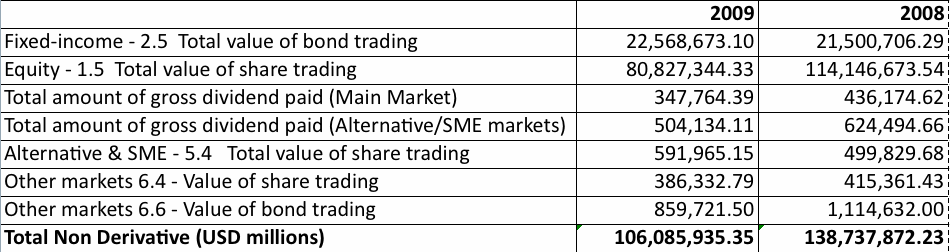
I can't help thinking that imposing a global financial transaction tax on all this would be a very good idea.
29 Dec 2010
Papers on Financial Transaction Taxes
I've just been using Google Scholar to find out what has been written on Financial Transaction taxes recently.
Several interesting documents can be downloaded easily.
Stephan Schulmeister, a researcher at the Austrian Institute for Economic Research, has published a number of papers including one called "A General Financial Transaction Tax: A Short Cut of the Pros, the Cons and a Proposal".
There's an IMF Working Paper by Thornton Matheson called "Taxing Financial Transactions: Issues and Evidence".
There's also a paper by Christopher Culp (a professor at the University of Chicago) called "Financial Transaction Taxes: Benefits and Costs'.
You can also find a paper by Zsolt Darvas and Jakob von Weizsäcker prepared for the European Parliament called "Financial Transaction Tax: Small is Beautiful".
There's a paper by Dean Baker (Codirector of the Center for Economic and Policy Research in Washington) that was prepared for the Bundestag in May that is called "The Benefits of Financial Transaction Taxes").
There's even a paper by Richard Page from the Georgetown University Law Center that even argues that FTTs couldn't work (!) - it's called "Foolish Revenge or Shrewd Regulation? Financial-Industry Tax Law Reforms proposed in the wake of the Financial Crisis"
Bill Barclay has a paper in a journal called Dissent called "Found money: The case for a Financial Transaction Tax" (unfortunately not downloadable).
But the nicest thing is that the number one paper out of 92 hits was a paper by someone called Simon Thorpe entitled "A Flat Rate Financial Transaction Tax to replace all taxes?" Well, I won't get too excited, because nobody has actually cited it yet, but I guess Google must have some way of deciding what to put at the top of the list.
Several interesting documents can be downloaded easily.
Stephan Schulmeister, a researcher at the Austrian Institute for Economic Research, has published a number of papers including one called "A General Financial Transaction Tax: A Short Cut of the Pros, the Cons and a Proposal".
There's an IMF Working Paper by Thornton Matheson called "Taxing Financial Transactions: Issues and Evidence".
There's also a paper by Christopher Culp (a professor at the University of Chicago) called "Financial Transaction Taxes: Benefits and Costs'.
You can also find a paper by Zsolt Darvas and Jakob von Weizsäcker prepared for the European Parliament called "Financial Transaction Tax: Small is Beautiful".
There's a paper by Dean Baker (Codirector of the Center for Economic and Policy Research in Washington) that was prepared for the Bundestag in May that is called "The Benefits of Financial Transaction Taxes").
There's even a paper by Richard Page from the Georgetown University Law Center that even argues that FTTs couldn't work (!) - it's called "Foolish Revenge or Shrewd Regulation? Financial-Industry Tax Law Reforms proposed in the wake of the Financial Crisis"
Bill Barclay has a paper in a journal called Dissent called "Found money: The case for a Financial Transaction Tax" (unfortunately not downloadable).
But the nicest thing is that the number one paper out of 92 hits was a paper by someone called Simon Thorpe entitled "A Flat Rate Financial Transaction Tax to replace all taxes?" Well, I won't get too excited, because nobody has actually cited it yet, but I guess Google must have some way of deciding what to put at the top of the list.
20 Dec 2010
Trading on the London Stock Exchange
I just wrote to the people at the Bank for International Settlements to ask why the data for the London Stock Exchange was missing from their latest reports (and has been missing since 2006). I got a rapid reply from a nice person who told me that the data in the report was provided by the Bank of England but that they don't currently report such figures. So, I had a look on the London Stock Exchange's own site where you can download everything. I have just compiled the total trading values on the LSE's UK Main market and the AIM market for the year ending end of november 2010. Here they are:

Yes, you read correctly. That's over 2 trillion dollars. A 1% transaction tax on that would already generate an extra 13 billion for the UK government in revenue.... enough to pay for a few social services.

Yes, you read correctly. That's over 2 trillion dollars. A 1% transaction tax on that would already generate an extra 13 billion for the UK government in revenue.... enough to pay for a few social services.
19 Dec 2010
Updated Information for Financial Transactions
I just had a look at the latest figures from the Bank for International Settlements which tries to provide detailed information about financial transactions for a subset of countries. It was their data that I used for the paper I wrote back in octobrer on the possibility of using a Flat Rate Financial Transaction Tax to replace all other taxes. My original conclusions were based on the data for 2008 (actually up until the 1st January 2008). The latest figures came out on the 7th of December and provide data for 2009 (actually dated the 1st January 2009). The new data show the effect of the financial crisis in 2008, because there was clearly a substantial drop in the amount of activity. Nevertheless my basic claim still holds up, because despite the crisis, the total amount of transactions for the countries covered by the BIS was 8512 trillion dollars, whereas total government revenue for the same set of 21 countries was 11.7 trillion dollars - ratio of 729 to 1.
I also updated the figures for the Goverment Revenue numbers, using the tables provided by the CIA that you can find here.

There are a few points worth stressing. Firstly, the new table includes some countries that weren't in the previous version. Specifically, the BIS has now added data for Brazil, Mexico, Russia, South Africa, South Korea and Turkey, making 21 countries in all.
Secondly, the totals for the financial transactions are very clearly underestimates. Although I added everything that was listed in the tables provided by BIS (which you can download here,) there are clearly large amounts of data that are missing. For example, have a look at Table 18 for the United Kingdom. It should provide information about the Total Value of Executed Securities and Derivatives Trading for the London Stock Exchange. Unfortunately, it just says "nav" - not available. Funny that. It's probably a totally mind blowing number. But the fact is that even without including that, the ratio of Transactions to Government revenue for the UK stands at 1619:1. That's right, financial transactions within the UK are over 1600 times higher that total government revenue.
Just imagine. A flat rate financial transaction tax in the UK at 1% would generate 16 times as much revenue as tht UK government currently gets from all existing taxes. Even 0.1% would allow all the current taxes to be abolished and still have money left over to pay for universities, social services, pensions etc etc...
What are we waiting for? Why are university fees going up to £9000? Why are 100 000 local government workers in the UK going to get a letter announcing that they will be made redundant in the next couple of weeks? Why are social services being cut back? And why are the traders in the city going to be given obscene bonuses yet again?? Because we are stuck with a stupid taxation system that needs to be scrapped and replaced by a simple, fair tax on financial transactions that would provide all the financial resources we could reasonably need.
I also updated the figures for the Goverment Revenue numbers, using the tables provided by the CIA that you can find here.

There are a few points worth stressing. Firstly, the new table includes some countries that weren't in the previous version. Specifically, the BIS has now added data for Brazil, Mexico, Russia, South Africa, South Korea and Turkey, making 21 countries in all.
Secondly, the totals for the financial transactions are very clearly underestimates. Although I added everything that was listed in the tables provided by BIS (which you can download here,) there are clearly large amounts of data that are missing. For example, have a look at Table 18 for the United Kingdom. It should provide information about the Total Value of Executed Securities and Derivatives Trading for the London Stock Exchange. Unfortunately, it just says "nav" - not available. Funny that. It's probably a totally mind blowing number. But the fact is that even without including that, the ratio of Transactions to Government revenue for the UK stands at 1619:1. That's right, financial transactions within the UK are over 1600 times higher that total government revenue.
Just imagine. A flat rate financial transaction tax in the UK at 1% would generate 16 times as much revenue as tht UK government currently gets from all existing taxes. Even 0.1% would allow all the current taxes to be abolished and still have money left over to pay for universities, social services, pensions etc etc...
What are we waiting for? Why are university fees going up to £9000? Why are 100 000 local government workers in the UK going to get a letter announcing that they will be made redundant in the next couple of weeks? Why are social services being cut back? And why are the traders in the city going to be given obscene bonuses yet again?? Because we are stuck with a stupid taxation system that needs to be scrapped and replaced by a simple, fair tax on financial transactions that would provide all the financial resources we could reasonably need.
11 Dec 2010
The cost of education...
How depressing. When I was a university student (1974-77), I got a grant that meant that I was almost self sufficient (at least during term time) - my mum and dad only had to contribute something like £50 a term. When my elder son Jonathan went to study a York university in the UK (2002-2005), fees were around £1000 a year. For our second son Kieran, who was at Warwick from 2006 to 2009, fees had gone up to £3000. Now, it has been decided that future students are going to have to pay up to £9000 a year in fees to be able to go to university. What has gone wrong?
Sorry to be boring, but I really believe that the problem lies in the fact that we are now all at the mercy of the financial markets. Governments are forced to accept massive cuts in public funding for all that is really important - education, research, the arts, social services - because they all fear that if they don't, they will be the next on the list of countries that are the targets for the speculators. The solution? A 1% Financial Transaction Tax.... It would provide enough revenue to pay off each countries debts, as well as allowing everyone to have a decent pension and an equal chance of higher education.
Sorry to be boring, but I really believe that the problem lies in the fact that we are now all at the mercy of the financial markets. Governments are forced to accept massive cuts in public funding for all that is really important - education, research, the arts, social services - because they all fear that if they don't, they will be the next on the list of countries that are the targets for the speculators. The solution? A 1% Financial Transaction Tax.... It would provide enough revenue to pay off each countries debts, as well as allowing everyone to have a decent pension and an equal chance of higher education.
13 Nov 2010
The Debt-Free America Act (HR 4646)
Following up yesterday's post about attempts to introduce a 1% flat rate Financial Transaction Tax in the US, I had a look to see what were the chances of the proposition being passed there. If you type HR 4646 in Google, there are a huge number of hits. Quite a lot of them concern very right wing conservative's who are totally opposed to any new taxes (even if they have the potential of eliminating existing ones). One of my favorites is this one where you can read:
"Let's say hypothetically that you are involved with 10-20 "transactions" daily. Then instead of paying a 1% tax you have now just paid a 10-20% tax. do you see how easily this can snowball?"
Clearly, there is a lot of explaining to be done....
"Let's say hypothetically that you are involved with 10-20 "transactions" daily. Then instead of paying a 1% tax you have now just paid a 10-20% tax. do you see how easily this can snowball?"
Clearly, there is a lot of explaining to be done....
12 Nov 2010
FTTs in the US
I've been a bit quiet for a few days - giving three talks in two days in San Diego, going to see the Beatles Love show in Las Vegas and flying back to Toulouse. But my discussions with colleagues in the US have been very interesting and I've been getting some really good feedback. At the afternoon tea in Terry Sejnowksi's lab at the Salk Institute (an institution created many years ago by Francis Crick), I talked about my suggestion of imposing a 1% Flat Rate Financial Transaction Tax to replace the existing taxes on income, profits and sales.
Terry just emailed me with some links toward some propositions that have already been made in the US. First, there was H.R. 4191 ("Let Wall Street Pay for the Restoration of Main Street Act of 2009") proposed by Peter De Fazio on December 3rd 2009. That bill was calling for a 0.25% FTT that would apply to t certain securities transactions, including transactions in stocks, futures, swaps, credit default swaps, and options.
Then, even more recently, there was H.R. 4646 "Debt Free America Act", a proposal from Chata Fattah with the purposes of raising of sufficient revenue from a fee on transactions to eliminate the national debt within seven years and the phasing out of the individual income tax. Amends the Internal Revenue Code to impose a 1% fee, offset by a corresponding nonrefundable income tax credit, on transactions that use a payment instrument, including any check, cash, credit card, transfer of stock, bonds, or other financial instrument. Defines "transaction" to include retail and wholesale sales, purchases of intermediate goods, and financial and intangible transactions.
Brilliant. Let's do it (and not just in the US)!
In a sense, I'm relieved. OK, I'm not the first person on the planet to have proposed the idea that a 1% FTT could replace income tax. On the other hand, I'm not alone!
Terry just emailed me with some links toward some propositions that have already been made in the US. First, there was H.R. 4191 ("Let Wall Street Pay for the Restoration of Main Street Act of 2009") proposed by Peter De Fazio on December 3rd 2009. That bill was calling for a 0.25% FTT that would apply to t certain securities transactions, including transactions in stocks, futures, swaps, credit default swaps, and options.
Then, even more recently, there was H.R. 4646 "Debt Free America Act", a proposal from Chata Fattah with the purposes of raising of sufficient revenue from a fee on transactions to eliminate the national debt within seven years and the phasing out of the individual income tax. Amends the Internal Revenue Code to impose a 1% fee, offset by a corresponding nonrefundable income tax credit, on transactions that use a payment instrument, including any check, cash, credit card, transfer of stock, bonds, or other financial instrument. Defines "transaction" to include retail and wholesale sales, purchases of intermediate goods, and financial and intangible transactions.
Clearly, Nancy Pelosi (the house speaker) is a supporter as can be seen from this report.
Brilliant. Let's do it (and not just in the US)!
In a sense, I'm relieved. OK, I'm not the first person on the planet to have proposed the idea that a 1% FTT could replace income tax. On the other hand, I'm not alone!
Subscribe to:
Posts (Atom)
It really does contain things like (on page 88)
2.16 The Government will extend the opt-in exemption regime for large and medium companies to all countries and territories, including those with which the UK has no tax treaty. The Government notes that this goes beyond the foreign branch exemption regimes of many other countries.
What on earth can we do? Well, apparently the government is currently in a phase of consulation about the taxing of foreign branches, and the closing date for comments is the 11th of February.
The document invites "interested parties" to reply to the following questions:
- How well does the draft legislation (to be published shortly on the HM Treasury website) put into effect the policy proposals set out above?
- How could the legislation be improved?
- What else should it include?
- Do you agree that new regime should be available for accounting periods commencing on or after a specified date in 2011?
And says that responses and enquiries should be sent to:Carol Johnson
Room 2/E1
HM Treasury 1 Horse Guards Road
London SW1A 2HQ
Alternatively, please email: carol.johnson@hmtreasury.gsi.gov.uk
Can I suggest that all the interested parties (i.e. UK taxpayers who will have to foot the bill) contact Carol directly to say what they think?
It goes without saying that these reforms almost guarantee that any big bank will be able to get away with paying virtually no tax at all. By some miracle, all the profits will be made offshore.
Given that the Conservative Party currently gets 50% of its income from the City, it is hardly surprising that their policies seem so obviously designed to provide a limitless supply of loopholes to allow the City to avoid paying its share of taxes.
Fortunately, there is a simple and fair alternative - a flat rate financial transaction tax.