30 Aug 2012

The causes of US government debt

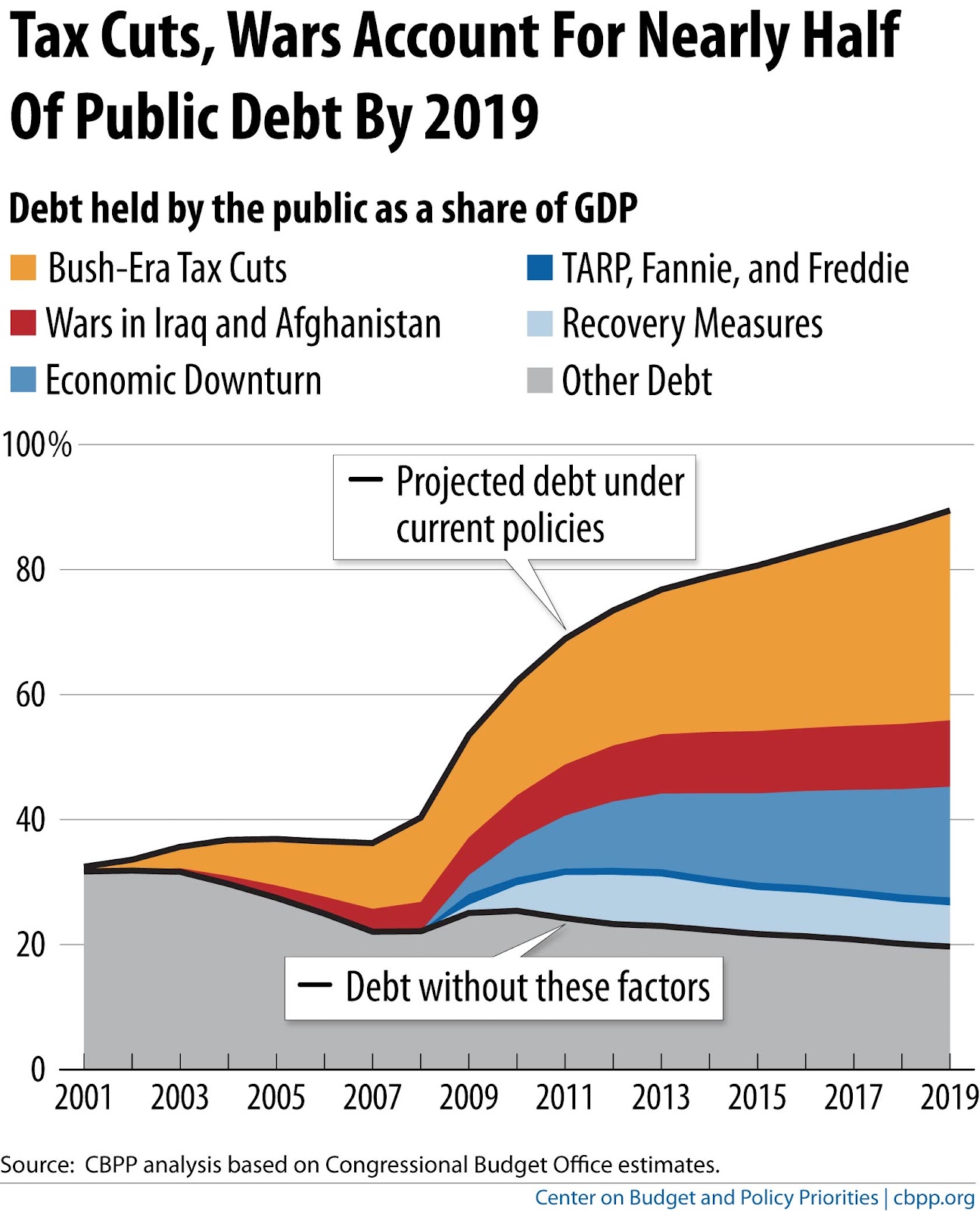
There's an interesting piece in Today's Washington Post. The report contains a graph produced by the Center on Budget and Policy Priorities that does something very simple. It takes US public debt since 2001 — which is the last year that the budget saw surpluses — and breaks it into its component parts. The graph plots the numbers as a percentage of GDP. Here is the figure.

It shows that half the projected public debt can be directly attributed to Bush-Era Tax Cuts and the cost of the wars in Iraq and Afghanistan. A fair propostion is the result of the economic downturn and the cost of various bailouts. Obama's recovery measures (light blue) are having a relatively modest effect.

What intrigued me in particular was the grey bit - "Other Debt". I wonder what is in there?

Well, in one of my earlier blogs, I looked at the US Treasury figures for the cost of interest payments on US Government Debt. Specifically, you can find numbers for the Interest Expense on the Debt Outstanding which includes the monthly interest for:
The total in interest payments in 2011 was $454,393,280,417.03. The USA's GDP in 2011 was $15.09 trillion, which means that 3% of the total is simply interest charges.

It goes without saying that if that 3% was removed from the bill by allowing the US Treasury to create the US Dollar money supply directly, instead of borrowing money from a consortium of private banks (i.e. the Federal Reserve), then things would rapidly get a lot better.

It would also help a lot if the super rich Americans who finance the Republican party actually paid the same level of tax that they paid pre-Bush, and if the US didn't plough so much money into fighting wars. But that's another story.

29 Aug 2012

Money Creation by Commercial Banks : The house price bubble

There was an interesting bit BBC Radio 4 this morning - a discussion with Karl Case who, with Robert Shiller developed an index for comparing repeat sales of the same homes in an effort to study home pricing trends, the Case-Shiller index.

The news is that today, the index has just gone slightly positive following an incredible period in which house prices had plummeted in the USA since the peak of the housing bubble in 2007. I extracted the graph from a press article, and you can see it here. You can see that year on year prices increases reached an unbelievable 16% at the peak, before dropping by up to 20% in 2009.


What amazed me was Karl Case's statement that the banks had pumped $10 trillion in new credit into the housing market between 2000 and 2005, and that because of the crash, $6 trillion of that value has simply disappeared in smoke. That's $10 trillion dollars that the banks just created out of thin air.

$10 trillion dollars! That is what happens when the money creation process is put in the hands of commercial banks. They create money for buying the same houses over and over again, causing a totally insane cycle of inflation that eventually ends with a crash.

I simply cannot believe that there is any reasonable way of keeping this sort of insane money creation under control unless the the money creation mechanism is changed fundamentally. If all money creation was done by central banks who would then allow governments to spend the money into the economy (or pay off debt), then such problems would be a thing of the past.

24 Aug 2012

Campaigners for monetary reform unite!

There seem to be more and more people across the world who have realized that many the real problems that face us could be fixed by reforming the money creation mechanism.

In my recent video, I said that while there are active and well-organized groups in the UK (Positive Money) and the USA (the American Monetary Institute, who are organising a very tempting Monetary Reform Conference in a few weeks time),  efforts in the Eurozone appear to be fragmented.

In the last few days, I've been in contact with a number of other people, including Joseph Huber who was the co-author with James Robertson of a very important book on "Creating Money : A monetary reform for the information age" that came out in 2000. Joseph is active in Germany where there are a number of vocal groups. But we were bemoaning the fact that there don't seem to be many people in countries like Greece, Spain and Portugal who have realized that monetary reform could be THE solution for them.

One of the most active groups in Germany is the Monetative movement. Joseph pointed out that they have an interesting list of sister organisations and websites that I recommend.

The list includes the AMI and Positive Money of course, but also
There is also a list of personal website's including a certain guy in France who has one called "Simon Thorpe's Ideas" (Thanks Monetative!!).

But there are loads of holes. Only 6 of the 17 Eurozone countries appear to have anything - correct me if I'm wrong.

There are a few other ones that I can add:
And we also need something at the European level. 

Given that Positive Money now has a New Zealand branch, could it be that we could build on the Positive Money framework and spread that across Continental Europe and in particular the Eurozone? Or maybe we could build up from the Monetative base?

Whatever option is chosen, it seems to me that we absolutely need to try and get an international movement going. And this is particularly critical for the 17 Eurozone countries. The current policies being implemented by Mario Draghi (ex European Director of Goldman Sachs, and now head of the European Central Bank) simply cannot be allowed to continue.

Louis Even and the Michael Journal

My thanks to Paul Nollen for pointing me towards the work of a truly remarkable man - Louis Even (1885-1974). He was a lay Christian leader who founded the social credit movement in Quebec and a movement called the Pilgrims of Saint Michael. The Pilgrims produce something called the Michael Journal which turns out to be a treasure trove of fascinating ideas.

Take for example Louis Even's fable about five people washed up on a desert ile, which explains how money is created as debt by private banks. The story was first published in 1940 in the magazine "Vers Demain".  It's a great story - just 8 pages long - that you can read in English "The Money Myth Exploded", French "L'île des naufragés", Spanish "La Isla de los Naufragos", Portugeuse "A Ilha dos Naufragos", German "Die Insel der Shiffbrüchigen" and Polish "Wyspa rozbitkow". No excuses - you have to read this.!

The "Michael Journal" is available in several languages.

In the English section you can find many true gems. For example:
As I say - a real treasure trove. 

Quantitative Easing - a fantastic deal for the very wealthy

The Bank of England has published a report in which it admits that the effects of its Quantatative Easing strategy has mainly benefited the top 5% of households, because they hold 40% of financial assets. You can read the full report here, and it was discussed in an article in today's Guardian - "Britain's richest 5% gained most from quantitative easing - Bank of England".

I had a look at the report, and one figure particularly grabbed my eye. It was the distribution of financial assets - the figure where you get to see that 40% of the assets are held by 5% of households.

I can imagine that in the break down was even finer, it would have been even clearer. The assets held by the top 1% of households will certainly be even more skewed, and the relative advantage would be even more eye watering.

Can we seriously be expected to believe that QE is a sensible way to put central bank money into the economy? It clearly  goes to people who are highly likely to move their assets out to tax-havens. The probability of anything even remotely like "trickle-down" is zero.

22 Aug 2012

TARGET : €2,159,025,000,000,000 in transactions since 2009

Yep. That's right. The European system for interbank transfers called TARGET (Trans-European Real-Time Gross Settlement Express Transfer System) has processed over 2 quadrillion euros worth of transactions since 2009.

You can get all the details from the wonderful ECB databank here.  Of course, you won't find the totals there. They only give you the total values month by month, and country by country. But, if you put all the numbers into an excel sheet, and add them up (something that I have done), you get the following
  • 2009 :                €551,172 billion
  • 2010 :                €593.195 billion
  • 2011 :                €612,936 billion
  • 2012 (Jan-Jul) : €401,722 billion
Since the average in 2012 is so far €57,389 billion a month, it looks like 2012 is going to be a truly bumper year for the banks. They should be able to manage over €688 trillion if they keep it up. That's over 12% up on last year.  It's nice to know that there are some people out there for whom business is booming.

Here's a table showing the breakdown country by country

Germany is obviously doing a lot for the levels of transactions, with a whopping €721 trillion - well done Germany! But France, Spain and the Netherlands aren't doing badly either, with over €300 trillion each.

One country is very notable by its absence - the UK. They don't want to join up with those in Continental Europe. So we can certainly add some more eye watering numbers for CHAPS (who had processed a total of  1 quadrilion pounds by the 25th of July 2011) , CLS Ltd ($4.8 trillion a day in 2011),  NYSE Liffe (who managed €2.67 trillion in a single day on the 13th of January this year) as well as many others.

The moral to all this? Well, just imagine if the 0.1% Financial transaction tax had been in place since 2009. The TARGET system alone would have generated something like €2 trillion in revenue for Europe.

And we are told that there is no money about. Something tells me that someone is pulling the wool over our eyes.

21 Aug 2012

Ending the Eurozone debt problem in a decade (or less)

In my latest youtube video on "How the Eurozone countries could fix the global economic crisis" I proposed that we should push to replace money creation by commercial banks (who charge interest on loans made with money that they create out of thin air) by direct interest free money creation by the European Central Bank.

I specifically proposed that the ECB should be able to generate at least as much money as the commercial banks have been doing. M3 has been increasing by around €450 billion a year since 2005, although the rate of increase reached a staggering €968 billion in the single year leading up to November 2007 (those are the numbers from the Eurostat website).

Could the ECB generate that much money in a year? The answer is clearly yes. They've already done it, since Mario Draghi pumped over €1 trillion of cheap money into the banking system in two rounds of financing in the space of just 3 months. And I have it on the word of the ECB that there was actually no upper limit to the amount that could be generated.

So, for the sake of argument, lets just imagine what could be done with €1 trillion of nice fresh debt free money.

Well, the proposition that I made in my video was that the newly created money supply could be simply divided up according to the populations of the 17 eurozone countries. What could the countries do with the money?

One option would be simply to use the money to get the countries out of debt. The table shows the populations of each of the countries and the percentage. It also shows how much they would get of the €1 trillion created by the ECB, the size of the government debt, and the number of years that it would take to pay off the whole loan.

Germany would pay off all its debt in 8.5 years, France in 8.7 years and so on. Even Greece would pay off all its debts in little more than 10 years. Even the worst case, Ireland, would be out of debt by 2025.

Can anyone explain to me why this is not a perfectly good way of solving the Eurozone debt crisis?
And this is based on the very modest suggestion that the ECB creates only the same amount that it just did for the banks, and the same amount that the banks themselves produced in 2007. Increase the amounts further and you could solve the entire problem in three years or less.

The reason why we don't do this is simple. It would mean that the commercial banks would be deprived of the €286 billion in interest that they extracted from Eurozone taxpayers in 2011 alone.  And if anyone else tries to tell you that there is no alternative to austerity to solve the Eurozone debt crisis, it might just be worth checking that they are not directly receiving some of the money that gets creamed off. Objectively, it is impossible to justify the current system - unless you are a member of  the 1% who are on the gravy train.

Oh, and by the way, fixing the Eurozone crisis this way could not possibly result in inflation. Since the governments would be paying off debts that correspond to money that the banks have created out of thin air, when those debts get paid, the money disappears in a puff of smoke. The banks cannot relend the money - especially if their licence to use fractional reserve banking to create more will have been removed. But at the same time, it would reduce the exposure of the banks enormously - something which normally they should like, except of course for the fact that we would have killed their golden goose.

So, given that the ECB could pump €1 trillion a year into paying off the Eurozone government debt without producing any inflation at all, there is no reason not to add a few hundred billion more every year for doing some even more useful things. 

Finally, the idea that the money is dispatched purely on the basis of population size means that those countries whose govenments have been prudent in the past will start getting money they can use for these other projects much more rapidly. Estonia would be able to pay off its debt in just a few months, and start doing useful stuff. Even Spain would be out of the red in only 5 years - way before the Germans, who, contrary to the myth, are actually the worst culprits of all for the size of their government debt.

In other words, there is real justice here. But justice is not something that seems to have a very high priority among our leaders.

19 Aug 2012

The Chicago Plan Revisited

My thanks to a couple of people who have pointed me to a new paper by a Jaromir Benes and Michael Kumhof from the IMF called "The Chicago Plan Revisited". The paper will be presented at next meeting of the American Monetary Insitute next month (see the program here). I also note that the appearance of this paper caused the people at the Positive Money group to enter a state of mild shock! It is indeed a real surprise to see an IMF working paper offering support for full reserve banking!

The paper looks really important because, finally, it has a look at some of the key claims made by the authors of the original Chicago Plan - published in the mid 1930s by a group of prominant economists. They were proposing exactly the sort of reforms that an increasing number of authors are arguing for today - including myself. Namely, the abolition of the ability of commercial banks to create credit (money) out of thin air, and the replacement of the money creation mechanims by central banks.

Here's what the abstract of the article says:
"At the height of the Great Depression a number of leading U.S. economists advanced a proposal for monetary reform that became known as the Chicago Plan. It envisaged the separation of the monetary and credit functions of the banking system, by requiring 100% reserve backing for deposits. Irving Fisher (1936) claimed the following advantages for this plan: (1) Much better control of a major source of business cycle fluctuations, sudden increases and contractions of bank credit and of the supply of bank-created money. (2) Complete elimination of bank runs. (3) Dramatic reduction of the (net) public debt. (4) Dramatic reduction of private debt, as money creation no longer requires simultaneous debt creation. We study these claims by embedding a comprehensive and carefully calibrated model of the banking system in a DSGE model of the U.S. economy. We find support for all four of Fisher's claims. Furthermore, output gains approach 10 percent, and steady state inflation can drop to zero without posing problems for the conduct of monetary policy."
 The text is full of interesting material. For example, when discussing the idea that central banks have can influence the amount of money creation by the commercial bank sector, the authors note that, "the “deposit multiplier” of the undergraduate economics textbook, where monetary aggregates are created at the initiative of the central bank, through an initial injection of high-powered money into the banking system that gets multiplied through bank lending... is simply, in the words of Kydland and Prescott (1990), a myth. And because of this, private banks are almost fully in control of the money creation process."

Nice to hear real economists admitting that this idea is a complete fiction. Commercial banks do precisely what they want.

The authors also note that "This is of course the reason why quantitative easing, at least the kind that works by making greater reserves available to banks and not the public, can be ineffective if banks decide that lending remains too risky." I think we can probably replace the "can be ineffective" by "is ineffective".

Perhaps someone could mention this to Mervyn King and Mario Draghi before they embark on yet another round of completely pointless Quantitative Easing.

Note added 22nd August:

Bill Still has a great and inspirational presentation on this subject  - "IMF Paper Supports Monetary Reform"
Do watch it!

18 Aug 2012

Latest Youtube Presentation : How the Eurozone Countries could fix the Global Economic Crisis

I have just uploaded a new 14 minute Youtube presentation entitled "How the Eurozone Countries could fix the Global Economic Crisis". I hope you like it. As always, please feel free to leave comments. I will try to answer them all.

The presentation takes up the themes that have been foremost in my mind in recent weeks. Specifically, I argue that the Eurozone countries could act together to provide a solution to the global economic crisis. The basic cause of much of the current mess is the money creation mechanism . Commercial banks currently have a virtual monopoly on money creation and, in recent years, they have been creating trillions of euros in debt by creating money out of thin air, lending that "money" to governments, businesses and individuals, and then charging interest on those loans. Governments are currently paying hundreds of billions a year in interest charges - thus crippling the economy.

I present some of my recent simple numerical demonstrations to show that such a system simply can never be made to work in the interests of the general population - economic power will inevitably end up with those who control the creation of the money supply - i.e. private bankers in the current system.

I argue that, if the 17 eurozone governments acted together, then could ban money creation by private banks, and require all new money to be created debt-free via the ECB. I propose that the money created this way could be distributed between the 17 countries pro-rata as a function of the size of each countries population.

A key advantage would be that the Eurozone economy would no longer have the inbuilt inflation required in currency areas where the creation of the money supply requires interest to be paid. This would make Euros very attractive relative to other currencies which are forced to continuously devalue. As a result, the ECB could create large quantities of Euros without risking inflation - thus providing a massive boost to the Eurozone economies.

I suggest that once a major currency block like the Eurozone has switched to debt-free money creation, it is highly probable that other currencies zones would be compelled to follow - thus ridding the world of the millstone of debt-based money creation.

You can find the video on my Youtube Video Site, or by clicking directly on the player below.

I want the earth : Plus Five Percent

For those who need someone else to tell them that the root of most, if not all, our current problems stem from the fact that our money supply is created as interest-bearing debt by commercial banks, I can recommend a 45 documentary called "I want the earth : Plus Five Percent".

It's based on  fable written by an Australian guy called Larry Hannigan in 1971. He had clearly worked out what was going on. You can find the original story on here, or an updated version (dating from 2009) here. There's also a pdf version to download here.

Great stuff. The video version has some extra bits at the end that describes how the takeover of the system has occured in Australia.
"The Federal Government already has the power and duty to create our money system with No interest and NO Debt" (Australian Constitution Section 51 and Section 115)."

"The Nullabour Railway, the Snowy River Scheme and many other projects were financed with No interest and No debt."

"So why has it not been done by any Federal Government since 1960?"

"The Commonwealth Bank (the peoples's Bank) was illegally "sold" 16 April 1991 to the International Banksters."
Sounds like it has been a similar story all over the world.  When will we wake up and do something to get this changed?

17 Aug 2012

How the money creation system hits ordinary people

There have been a number of recent reports that have really highlighted just how the insane money creation mechanism that we have is having totally devastating effects on ordinary citizens in the UK.

First, house price inflation. An article in today's Guardian describes the result of a report from the National Housing Federation showing that "in 2001 the average price of a home was £121,769, and the average salary was £16,557. In the space of ten years the price of a home has rocketed to £236,518 – an increase of 94% - whereas wages have risen just 29% to £21,330, making buying a home increasingly unaffordable for millions of workers". Not only have the prices risen way faster than wages, the amount of deposit required has also increased enormously. We learn that "In 2001 the deposit for a typical 90% mortgage was £12,177, about nine months' salary.... Now, because banks and building societies have tightened their lending criteria, a buyer can typically expect to put down a 25% deposit at £59,129, almost three years salary."

Where does the blame lie for these ridiculous rises? Hopefully you will already know that the origin lies in the fact that commercial banks have been given virtual monopoly on money creation. And when commercial banks get to decide on where to put newly created credit, their number one priority tends to be lending to people to buy houses - and in particular,  houses that already exist. Result - a house price bubble that has left many people in a position where finding somewhere affordable to live is a distant dream.

That brings me on to a second subject - the appaulingly low rates that banks offer to savers. According to another report in today's Guardian,
"With the consumer prices index now at 2.6%, a 20% basic rate taxpayer needs to find an account paying 3.25% to offset the impact of inflation. A 40% taxpayer needs an account paying at least 4.3%.
According to Moneyfacts, which monitors UK savings products, there are 1,092 savings accounts available on the market and only 227 of them will offset the inflation rate (and then only just). Of those, 128 are ISAs and 96 are fixed-term accounts. There are just two notice accounts that allow savers to stay ahead of inflation (by 0.05% and 0.1%) and not a single no-notice account."
Why are interest rates so low? Well one reason is that banks really have no incentive to try and encourage saving. Since the Bank of England will happily lend them money at 0.5%, why would they bother offering higher rates to attract savers? Furthermore, since they can use fractional reserve banking to create more money out of thin air, there is clearly going to be no need to go chasing after savers.

Of course, if banks were no longer allowed to create their own money, they would be forced to try and attract savers. Yet another reason why we need to get rid of the current corrupt and stupid system.

Finally, there is the general question of inflation.  An editorial in Tuesday's Guardian discussed the latest figures from the Office for National Statistics. In the last five years, food prices in the UK have shot up 28.7%. Electicity, gas and other fuels have shot up 45.5%, and transport costs by nearly 25%. I had a look at the dataset from the ONS, and compiled the following table that shows the increases in price index for the 124 different items in their "shopping basket". The numbers give the increase in prices using 2005 as a baseline of 100.


The table makes for sobering reading. Gas prices have more than doubled. So have postal services. Anything to do with energy and transport are through the roof. How can we explain those increases? Surely, if money is in short supply, there should be a tendency for prices to increase more slowly.

Well, not necessarilly. When energy and transport companies have been privatised and their shareholders are looking for very high returns, then those companies will be tempted to increase prices as much as they can. And for food prices, don't forget that the ability of commercial banks to create money that can be used to speculate on the prices of basic commodities means that here again, a lot of the problems can be traced back to the same original cause: the fact that the money supply is created by commercial banks for profit.

It is definitely time for a change

Money Creation : How about turning the tables?

It's funny how, when you realize that there is no reason why the monetary system has to be the way it is currently set up, you see that there are a whole host of alternatives that could be used. We are literally spoilt for choice. The problem is that there is absolutely no discussion about such issues. We behave as if the current system is there because it is written in stone - an unavoidable fact of nature.

Most people don't realise that virtually all the money in the economy has been created out of thin air by commercial banks, who lend "money" to individuals, companies and governments, and then charge interest. But, even if you are one of the relatively small number of people who have worked out that the system has been rigged,  then there is a pretty good chance that you will think that since it has nearly always worked that way, that it is impossible to change.

Not true.

If we had a truly free debate on the subject, it would be clear that there are countless alternatives that could be used.

I've been pushing for the idea that all money creation should be debt free. Central banks should create the money supply debt-free and governments should spend the newly created money into the economy for financing projects that are in the public interest. I was thinking that maybe this should be a general rule - that anyone vested with the authority to create the money supply should be forbidden from charging interest.

But then I thought that maybe this was not the only option. How about a situation where governments can still spend money debt-free directly into the economy, but where they can also lend money, with interest, in certain cases. Would this be a good idea? Well, suppose that those who could benefit from such loans were the commercial banks. That would mean that when the government (or the central bank) lends the commercial banks money, those banks could be required to pay the same sort of average interest rates that the governments are currently forced to pay to the commercial banks - namely, around 5%. Now, that would be a real change. It would now be the banking system that has to pay the interest charges for creating the additional money supply, rather than taxpayers.

Looked at this way, this could be a rather neat way of effectively getting tax revenue for the government. That is because interest payments that the banking sector would have to pay to get their hands on additional newly created money would effectively act as a tax.

Consider a situation where the government uses the central bank to generate €200 billion of new money a year. And suppose that while €100 billion of that is spent directly into the economy, with no interest to pay, the remaining €100 billion can be borrowed by commercial banks for financing other activities that are less directly public in nature. If the banks had to pay 5% interest on that money at the end of the year, that would be an extra €5 billion in revenue for the treasury every year.  And if, as is currently the case for governments, the banks didn't pay off the debt at the end of the year, they would continue paying €5 billion a year indefinitely. And, just as with government debt, you could end up with a situation where, after 20 years, the banks would have paid a total of €100 billion and still not paid off the original loan.(Actually, something tells me that the banks wouldn't be so stupid as governments currently are - they wouldn't let the debt rollover from year to year - only our governments are that stupid).

So, maybe allowing money creation with interest is OK - just as long as the interest charges go to the government and are used in the public interest, rather than going to provide unjustifiable profits for commercial banks.

As I say, the range of options is enormous. But what is lacking is any real debate. And I suspect that this absence of debate is because the banks have used a substantial part of their massive revenues to buy the vast majority of politicians, economists and journalists.  That is why it will largely be up to independent thinkers and ordinary citizens to bring the spotlight on these vital questions.

16 Aug 2012

Money creation for interest : A truly insane system

A couple of days ago, I used my blog to show that allowing commercial banks to create money and charge interest is a sure recipe for disaster (see "The Money Creation Racket must end").  I gave the example of an island where a commercial bank is allowed to create €1,000,000 of money, which it lends to the population at 5% interest. Irrespective of how things are run, the inevitable consequence is that after 20 years or so, the bankers control the economy. Either they use the interest payments to pay themselves huge salaries, which they can then spend back into the economy, or their create more money every year to provide the population with enough new money to pay the interest on the previous loans.

I mentioned one further variant in which the bankers not only create enough new money every year to both cover the interest payments, and give people enough extra money to give them the impression that things are improving.

To make the story clear, I decided to fill in the details of this. The table shows what would happen if the bank loans out enough money to allow the interest for the previous year, but in addition provide a roughly 2% increase in the free money - what I call "People's Money".

You can see that the population does indeed get an increase in the amount of available cash - increasing from €950,000 at the end of year one, to over €1,350,000 after 20 years. This would allow them to get a 2% increase in salary every year. Great! But, at the same time, the total money supply is going through the roof - increasing from €1,000,000 in year one to €3,335,961 after 20 years. The really critical feature is that nearly €2 million of that money has been paid to the bank in interest charges - meaning that the bank now has nearly 60% of the entire economy.

The consequences of this will depend on what the bank does with all the money it rakes in. If it spends the money back into the system, then the automatic consequence will be inflation. Goods that could be bought for €10 in year one, will probably cost nearly 3 times as much after 20 years. Alternatively, it could just hoard the money or transfer it to some other island.

But perhaps even more importantly, having all that money gives the bank the power to pay anyone who might threaten to derail the gravy train by exposing the scam. That allows them to keep the system going for their benefit. You can imagine that it would be particularly important to pay the politicians, economists and journalists enough to keep the scheme out of the spotlight.

I would just love to hear anyone trying to defend the current money creation system - a system in which the money supply is created by commercial banks with interest attached. I am certain that anyone who tries to convince us that it makes sense to do things that way is either (a) stupid, or (b) being paid to keep the gravy train going.

It is definitely time to put an end to this fiasco.

Helicopter Money : Not the right answer

This morning's Guardian has an article saying that nearly half of the economists who originally backed Cameron and Osborne's austerity program are now saying that the government should be borrowing money to invest in infrastructure.  You can see the original report in an article in the New Statesman.

Well, I suppose you could call that progress. There appear to be some economists who have realized that they were previously talking rubbish.

But apparently none of them seems to have realized that the idea that governments should be borrowing money from commerial banks makes no sense. The Bank of England can create money, as it did when it happily generated £375 billion of quantitative easing that it pumped into the financial sector - with no useful effect.

Surely, there must be better things to do with central bank money?

One option that has been proposed by a number of people, including Simon Jenkins, writing in the Guardian, is the idea of "helicopter money", an idea that was apparently originally mooted by Milton Friedman. The government simply prints lots of new bank notes, and drops them out of helicopters. People scramble for the notes and then use the money to spend into the economy.

It is admittedly a better way of injecting new money into the economy than the one that we currently have. Right now, commercial banks create new money as debt. So any increase in money is automatically associated with getting yet money people (companies or governments) even more in debt. But you cannot borrow yourself out of debt. Helicopter money does have the advantage that it gets money into the economy without the need to increase debt further.

When will politicians and ecnomists and journalists realize that there is absolutely no problem with the government spending newly created money into the economy. The power to create money and decide where it goes is far too valuable to just chuck it out of a helicopter. Here are some examples of what an intelligent government could do.
  1. New money could be used to build low-cost rented public sector housing - allowing ordinary citizens to find somewhere decent to live. It would provide a much needed boost to the construction industry. But in addition, if the houses were built and owned by local councils, they would provide a much needed source of rental income - a source that all but disappeared following Thatcher's selling off of council houses in the 80s. 
  2. New money could be used to build better public transport systems. This would have a massive long-term benefit - allowing people to get to work far cheaper than now. In the UK, rail fares have been going up far faster than inflation for years - with the latest fare increases of 6.2% due next january meaning that many commuters will be paying over £5000 a year for a season ticket. We are told that this is to cover the need for investment. Well, why not use newly created central bank money to build the new infrastructure. The savings on transport costs and delays would mean that all British industry would be better off.
  3. Building hospitals using private funding has proved disastrous for everyone except the people who will be raking in the fees for several decades. Direct government investment, with no debt attached is a perfectly sensible way on financing projects that a clearly in the interests of all citizens.
So, no. Helicopter money is not a solution. Debt-free public financing of projects that are directly in the public interest is the most intelligent way to get money into the economy.

14 Aug 2012

The Money Creation Racket must end

Inspired by my last post, in which I tried to explain why the current system is rigged to allow the financial sector to take over the economy, I thought it would be amusing to provide a detailed numerical illustration of why the current system must be changed.

Imagine an island with a commercial bank that has been given the right to create the money supply and charge interest on the loans. At the beginning of year 1, it creates €1 million and loans it to the population who then use the money to go about their everyday business.  Suppose that the bank is  allowed to charge 5% interest. At the end of year one everyone has to cough up, and the bank gets €50,000 in interest charges. As you can see from the table below, a system designed like that would be a total disaster because, after 20 years, all the money has gone.
One option for the bank would be to recycle the interest they get paid on the original loans. For instance, this could be done if the people running the bank paid themselves enormous salaries. That way, the system could be maintained, but obviously there would be some extremely well paid people, and a lot of people who would effectively be their slaves - they would have to work for the bankers to get enough money to live. They could work as cleaners, cooks or gardeners for the bankers for example. It's still not very satisfactory - people might realize that they were being ripped off and insist that the system is changed.

Another option for the bank is not to require that the interest be paid. Just add it to the existing debt. Thus, at the end of year one, the population of the island now owe the banks €1,050,000. And that means that there will be even more interest to pay the following year. Leave that system running for 20 years, and the debt will have increased to over €2.5 million and the banks will effectively own over 65% of the economy.

But there even more subtle ways of rigging the system, that are maybe even more like reality. In one such alternative scheme, which requires being pretty crafty, the bankers don't just create the €1 million at the start of year one. Instead, they create enough new credit every year to pay the interest that the people had to pay the previous year. If they do this carefully, they can make sure that the total amount of "people's money" in circulation is keep constant. People will actually be paying off all the interest they owe - it won't be rolled over. However, it is just as effective at allowing the bank to take control of the system.

In the next table, you can see that, with this scheme, at the end of year one, the "people" have €950,000 (they've just paid the bank €50,000). But if the bank is careful and creates just enough new money every year, it is possible to keep that number completely stable. People will have the illusion of still having money, and paying off their debts to the bank every year. 


To get this to work I had to use a rule where the banks create an amount that is precisely 5.26316% more than the amount of interest paid the previous year. Don't ask me why it has to be that number. There is presumably a way of calculating this value, but my maths skills aren't up to it. Nevertheless, as you can see, by using this magic value, the amount of money in the economy is adjusted so that the amount that hasn't been paid in interest to the banks stays fixed. The "people" have the impression that they still have the same amount of money as they had at the end of year one.

In this case, even after 20 years, there is still the same amount of free money. But you can see that the total money supply has gone up from €1,000,000 in year one, to €2,650,034.  The obvious and inevitable consequence of that is inflation. Even if the people are keeping their salaries constant, they will be able to buy less and less every year.

The other remarkable feature is the amount of money that has been siphoned out of the economy in the form of interest charges- a whopping €1,700,034. Effectively, the bank will have accumulated a 64.2% share of all the money in the system.

There's yet another option for the bankers. Instead of just keeping the amount of "people's money" constant, as in the example I just gave, the bank can pump even more credit into the system. Give people even bigger loans to buy houses, flat screen TVs, holidays. That way they get the impression that they are rich.  You can even make it seem as if the economy is booming. But, in fact, the so-called boom is illusory. It is simply the result of people getting more and more into debt.  In the end, though, the most significant result is that after 20 years, the percentage of the economy that is in the hands of the bankers and their friends will be even higher than 64.2%.

What could the bank do with all the that money that they get from those interest payments? Well there are lots of things that could be done. For example,
  1. It could use part of the money to pay the people in the bank huge salaries and bonuses. 
  2. It could just move the money to somewhere else (like the Cayman Islands, or to buy other currencies if such things exist). 
  3. It could buy up the media to make sure that nobody gets to talk about what is going on. 
  4. It could pay all the economists not to say anything, even if they do manage to work out what has been going on. 
  5. It could pay the politicians who decide how the system should work and make sure that none of them even dares to suggest that it might just be more sensible for central banks to generate the money supply debt free to governments. 
I suspect that this is a pretty clear description of the current situation.

One last point. I stopped the table after 20 years of running the scheme. At that point, the financial system has increased the money supply by 265%. Since there is so much more money around, there will have been massive inflation, meaning that ordinary citizens will effectively be much poorer. It now has control of 64.2% of the economy.

But it won't stop after 20 years. Give the system 100 years, and the money supply will have increased to 471 million. 99.8% of that will be in the hands of the bankers and those in the financial system. And the ordinary citizens will be left with just a few crumbs, unless, of course, they are prepared to play along with the bankers and reap the rewards you get for keeping the gravy train on the rails.

 It is clearly time for a change.

1) Money creation by commercial banks should be BANNED. It is demonstrably a complete racket. And I defy anyone to defend it.
2) All money creation should be done interest free by central banks and used directly by governments for financing activities that are in the public interest.

Why the Eurozone should take the plunge

In my "Eureka" post yesterday, I argued that the first currency block to take the plunge, ban creation of the currency by commercial banks, and funnel all money creation by the central bank though the elected governments on a pro rata basis, using just the size of the population as the criterion, would have a major advantage over other systems.

The more I think about it, the better it seems.

Here's why. The fundamental difference is that when the money supply is created by commercial banks, they charge interest. When they lend to governments, they typically charge 5-6%, although if they don't like your politics, they can impose the 25.82% that Greece is currently having to pay. And of course, if the government does what the markets tell them and block financial reform, they get super low rates like the 1.24% that Germany currently gets charged. Note that even that super discount rate is substantially more than the ECB charges the banks. That's just government debt. What about the interest that gets charged for creating money and lending to consumers and companies. I have been unable to find any overall figures, but just note that credit card companies and loan companies will happily charge you 15-20% (I won't even mention the 14,368% charged by the payday loan sharks in the UK, because that particular English Disease seems not to be present in the Eurozone).

Since essentially all the money is produced as interest bearing debt, it follows that you need to have inflation. Central banks such as the ECB and the Bank of England aim to have inflation at 2%. Why? Because you need to have price inflation to be able to pay the interest charges. To see why, imagine an island with a bank that lends out 1 million currency units to people to spend, but requires them to pay back the money with compound interest at 2%. After 35 years, the people on the island would have paid 999,890 of the currency units to the bank in interest charges.

There are various scenarios possible. One is that the bank keeps all the interest for itself. It could, for example, move all those interest charges to another island (let's call it the Caymans). If they did, there would be just 110 units of money in circulation (999,890 is 2% of a million, compounded over 35 years).  Maybe people would object a bit.

A second option is that the bank could be nice and put the money gained in interest charges back into circulation. One way to do this would be by paying its directors and traders massive bonuses. In that case, you would have an island where 99% of the population was living and poverty, and 1% (those who were in the banking system) living the life of kings and driving around in Ferrari's paid for with this years bonus. Sounds rather familiar to me.

Actually, there's a third way, which goes some way to masking the level of the scam. And that is to pump more money (i.e. debt) into the system every year. To provide enough money to pay the 2% interest charges, you would need to pump at least 2% extra every year to keep people reasonably happy. By getting them to take on more debt, they would be able to buy those flat screen TVs and have the impression that they were reasonably well off.  After 35 years, the bankers would now have half the money in the system, and the people would have the other half. That's pretty much the situation we have now.
The one obvious drawback (apart from the fact that it is outrageously unfair) is that there is now twice as much money around (the original 1 million, plus the 1 million that was gotten by the banks in interest charges). And with twice as much money around, there has to be inflation at about 2%. Everything will  go up in price every year by about 2%.

In other words, the 2% inflation target is the price we all have to pay to allow a system to operate in which the money supply is provided by commercial banks who charge interest.

OK. End of explanation.

Now what is the relevance for the idea of the Eurozone switching from money creation as interest-bearing debt by commercial banks, to debt-free public money creation by central banks? Well, the fact is that in the new Eurozone, there is no need to pay the interest charges to the banks. And because there are no charges, you don't need to pump extra money into the system just to keep the system running. And that means that you could have a currency zone where there was no inbuilt need for inflation.  If 10,000 euros is enough to buy a Eurozone-constructed car in 2012, there is every reason to believe that you could get something equivalent in 2022 for the same amount of money.

So, let's suppose that you have a million dollars and you want to put the money in a safe place for your retirement. You have a choice of leaving the money as dollars, or alternatively, you could trade your dollars for euros. What should you do?

Well, unless I'm horribly mistaken, you would be well advised to choose to convert to euros. Why? Because in the dollar zone you will be living in a world where commercial banks are pumping hundreds of billions of credit into the economy every year and requiring that people find the money to pay the interest. And that means one thing. Inflation. Your $1 million might buy you a lot today, but in a few years time, you are almost guaranteed to have lost out unless you are clever and find a way to make more money.

In contrast, if you change to Euros, you can be much more confident that your savings will still be worth something when you get to retire. As a consequence, I would predict that as soon as the Eurozone countries make the shift to debt free public money creation, everyone will be tempted to convert their money into Euros. In turn, this means that there will be a lot of demand for Euros, and the ECB would be able to open the taps for creating more Euros. That money would be given directly to the 17 eurozone governments who would be able to spend the money directly into their local economies - building efficient transport systems, renewable energy, schools, hospitals, universities, research, social services etc etc... whatever their citizens want.

Is this too good to be true? Well, I'm having a bit of difficulty myself in grasping just how revolutionary this would be. Certainly, I am not aware of any economists who have seriously modeled this key issue of how a mixed world where the money creation mechanisms for dollars, pounds and euros  is so radically different. If there are any economists reading this who would be prepared to help analyse the situation, please do get in contact.

In the meantime, I am feeling absurdly optimistic.


13 Aug 2012

EUREKA! A way out of the crisis?

At 5am this morning, I awoke with an idea that may just be really important. Maybe it was the excitement of the Olympics, of seeing over 10,000 sportsmen and women from 204 different countries, coming together to celebrate what is good in humanity. Maybe I was inspired by that. But, in any case, I really think that I may have a proposition that could provide some light at the end of the tunnel.

So, what's the idea?

First, let's recap on the world in which we currently live. Commercial banks have been given the right to create virtually unlimited amounts of money (credit) in the form of interest bearing debt. Paying the interest on those loans costs taxpayers something like $1 trillion every year.  In the case of multinational banking corporations like HSBC, Credit Suisse, Goldman Sachs etc, they can create money in any currency they like. And, thanks to the existence of a system where they can convert from one currency to another, at no cost, this gives them enormous power. If the banks decide to, they can flood the markets with dollars, pounds, euros, swiss francs, yen or whatever. And they can move the money around from one place to another, making free use of taxhavens to hide their activities. Every three years, the BIS provides some numbers on the level of these foreign exchange swapping activities - at least $1000 trillion a year.

Most of the people I know who have been proposing that this system needs to be changed - people like Ellen Brown, Bill Stills, Stephen Zarnlenga, James Robertson, Joseph Huber and Ben Dyson - have been taking a rather local view. They have been arguing that the US Treasury should take over the money creation process in the USA, or that the Bank of England should be in charge of money creation in the UK. Strangely, I've not yet come across many people arguing for the same sort of action in the case of the Eurozone and the ECB (do let me know if there are any groups out there).

But a second point that strikes me is that I haven't heard anyone talking about what would happen if a single currency zone were to impose a shift from money creation by commercial banks to debt-free creation of the money supply by central banks. However, my Eureka moment at 5am this morning was the realisation that such a move could be very, very intereresting.

The bankers are not going to give up their right to create money easily. Nor will they accept that there should be restrictions on foreign exchange. OK. So leave them the right to create money in other currencies.

Suppose that tomorrow, the Eurozone governments got together and passed a law making it illegal for banks to create new Euros. The banks would still be able to create credit in other currencies such as dollars and pounds. But any bank that extended credit in Euros without having the funds to cover the loan would be charged with counterfeiting. If they wanted euros, they could always create some dollars, and then buy the euros. But the supply of euros could not be increased by the banks.

Now, obviously, people need euros. In particular, if you are living in a eurozone country, you are obliged to pay your taxes in euros. Since the banks are no longer able to create euros at will, there will probably be an increased demand for euros. Indeed, since investors know that the supply of euros cannot be increased at the whim of some powerful bankers, they would probably feel that having euros is safer than having other currencies.

When people start trading other currencies (which can be generated by banks) for euros, this could lead to the euro increasing in value. So, what do we do? Well, we get the European Central Bank to do its job by creating more euros so that the relative value of the euro (and hence prices) remains stable. But what will the ECB do with the money? I would propose that it simply gives the funds to the governments of the 17 eurozone countries to spend into their economies. Not in the form of an interest bearing loan, but simply as a donation. The money could be specifically used for projects that are in the long-term interests of citizens. It could be used for infrastructure spending, including the development of transport and energy systems. It could be used for educational purposes, by building new schools and universities, providing grants to students. It could be used for financing research. You name it. If it is in the interest of citizens, then it can be used.

How many euros would have to be created by the ECB and spent into the economy by the 17 eurozone governments to keep the value of the euro stable? Well, I'm only guessing, but I suspect that the answer is probably very large. At least as big as the trillion euros or more that were being generated by the commercial banks every year between 2006 and 2008.

Imagine that. Huge amounts of euros could be generated centrally and under full public scrutiny. And yet, at the same time, the commerical banks are still able to create their own credit in other currencies. They can still create dollars, pounds and swiss francs. And they can buy euros with their own fictive money. But whereas there are no controls on the volume of dollars and pounds that can be produced (which means that they are more risky), such variations in value for euros can be controlled by the central bank.

I suspect that once a powerful and important currency like the Euro has made the shift, then the other currencies would be forced to act in the same way. 

One last thought. You might think that a major problem would be to decide how much of the newly created ECB money supply should go to each of the 17 eurozone countries. Indeed, it could be tough sorting that one out. So, how about simply dividing up the money pro rata with the number of inhabitants in each country. That would immediately provide a relative boost to those countries which have been suffering the most as the result of the market-imposed austerity - countries like Greece, Spain and Portugal.

That's all for the moment. I'll be thinking hard about the implications of the idea, and will no doubt come back with further thoughts in the days to come.  And I would be very happy to hear your comments.

11 Aug 2012

European Securities Trading : €1000 trillion in 2011

I love the ECB. They provide all sorts of wonderful data on their website. For example, if you go here, you can download a pdf file with a list of all "Transactions processed by central securities depositories" (go to page 4). If you play around a bit, like me, you can download the raw data from here. 

And here are the numbers for 2005 to 2011. My previous data only went up to 2010 when the total value was a whopping €916 trillion. Here's the new data for 2011 - sorted by the volume of transactions in millions of Euros.


As you can see, the financial crisis doesn't seem to be having too much of an effect on the traders. In 2011 they reached a very impressive €995.3 trillion - up a healthy 8% on the previous year. Is it OK if I call that a round €1000 trillion?

All this is very nice, because as reported recently, François Hollande has just instigated a 0.01% tax on this sort of trading. Applied across Europe it would generate €100 billion a year. And with a more generous 0.1%, we could rake in a trillion a year. That would limit the need for austerity a bit.

What are we waiting for?

More on Money Creation in the Eurozone

I've been looking further into how money creation is handled within the Eurozone. As you hopefully already know, commercial banks have an almost total monopoly on creating new money. And, of course, when commercial banks create the money supply, which they do by waving the fractional reserve banking wand, they get to charge interest. It's a wonderful system for the banks - they literally get money for nothing. But it is a total disaster for the Eurozone's governments and taxpayers, who have ended up paying €4.48 trillion in interest payments to the banks since 1995.

But it doesn't stop there. The commercial banks also create the vast majority of the money that the rest of us use. How much?

Well, the European Central Bank actually provides quite detailed information about this. You can download a pdf file here, or download the complete dataset here.  A few months ago, I had already plotted the increase in M3, which is a fairly broad measure of the total money supply. That number had reached €9.87 trillion at the end of March this year. But I thought I would have a look at a breakdown of the figures. Here they are. I have charted the annual change in a variety of measures, together with the total outstanding amounts as of June 2012 - the bottom line.
As you can see, the total M3 has gone up again - reaching €9.93 trillion at the end of june. Indeed, with a very few exceptions (shown in red), the figures are nearly always positive - i.e. the banks are continuously pumping new money (i.e. debt) into the system.

But I was most impressed to see the numbers for "Credit to other Euro area residents" which was going up by over a trillion euros per year in 2006-8, reaching a peak of 1.39 trillion in the year up to June 2008. The total amount outstanding is now €13.36 trillion, even though the amount of credit actually shrank by €112 billion in the last year.

As far as I am aware, there are no numbers on how much interest this outstanding debt generates for the banks. If we assume around 8% per annum, it would be over €1 trillion.

The key question is this. Is this the best way to create the money supply? As with the figures from the World Bank, we can see that the commercial banks have been pumping hundreds of billions worth of money (debt) into the Eurozone economy every year. They get to choose where the money goes, and they get to charge trillions in interest charges on the "money" they lend. Much of the money gets used for fueling housing bubbles, or for buying imported flat screen televisions. And when it is not used to fuel consumer debt, it is being used to provide loans to speculators and for takeovers and mergers.

Just imagine another way of doing things. Suppose that we make it so that commercial banks can only lend money that they actually have. Suppose that they are no longer allowed to create money out of thin air, and charge money for lending that "money" to invididuals, companies and governments. Suppose that, instead, the creation of the money supply is the job of elected governments via central banks such as the ECB. And suppose that the central bank, instead of throwing over 1 trillion euros at the commercial banks and praying, the ECB provides the same amount of money that has been traditionally created by commercial banks for profit, but instead provides the money to governments which spend the money directly into the economy. And most importantly, suppose that the money is provided DEBT FREE.

Would this alternative system work better than the one we have? You bet it would.

What are the arguments that we have for keeping the existing system? I can think of only one - and that argument is totally phoney. We are told that allowing central banks to provide money debt free to governments would be inflationary. We are supposed to believe that the trillions of new money created by the commercial banks every year is not inflationary, that it doesn't cause property bubbles, that the trillions in interest charges that taxpayers end up paying to the banks is a good way of keeping inflation under control, and that the current system has not been rigged so that a powerful few can take all the benefits.

Sorry. I don't believe a word of it.

9 Aug 2012

What could the Eurozone Governments do with $600 billion a year?

Yesterday, I was arguing that the Eurozone would be a great place to try a new way of creating the money supply. I am one of an increasingly large number of people who believe that the current system, in which commercial banks have a virtual monopoly on money creation makes no sense. Commercial banks should only be able to lend money that they actually have. Instead, creating the money supply should be the job of elected governments.

To help think about what this would imply, I have extracted the figures on Net Domestic Credit for the 17 Eurozone countries from the WorldBank database, and calculated the change in level for every year from 2000 onwards. Here are the figures.

As you can see, the figures are impressive. Since 2000, the banks have pumped €6.6 trillion of credit (i.e. debt) into the Eurozone, an average of €600 billion a year.  The peak was in 2007, when the total reached €1.28 trillion.

Now, suppose that all this money was not created by commercial banks, who lend the "money" to individuals, companies, and governments and then charge as much interest as they can. Suppose that, instead, the same amount of money was created by the European Central Bank and provided to the 17 Eurozone countries to spend into their economies.  The first point is that if the ECB created the money, there would be no need to pay interest on the loans. In fact, there is no need for the money to be provided as a loan at all. It could literally be created and spent into the economy directly - with no debt. I am convinced that this would be a much more sensible way of creating the money supply.

The second question to ask is whether the governments could use the money more intelligently that the commercial banks who currently create the money supply. Well, to see a bit what the banks have been doing with their monopoly on money creation, lets have a look at which countries got most of the money (debt). Here are the figures since 2005.


As you can see, the average for those years was €768 billion, of which over €213 billion went to Spain. And what did that money get used for? You are probably well aware that the money went directly to finance the total ridiculous housing bubble in Spain, that has resulted in building literally millions of holiday homes along the Spanish coast, many of which have not even been finished. A housing bubble that has literally destroyed the Spanish economy and left 25% of the population unemployed.

What a criminal waste of resources. What a perfect demonstration that leaving the creation of the money supply in the hands of irresponsible bankers is about as stupid as you could get. Something tells me that if the 17 governments were forced to sit round a table and decide where the newly created money should go, they would definitely not agree that 28% should go to finance the construction of new property in Spain.

I cannot believe that anyone could argue that the politicians in the Eurozone could not come up with a more intelligent way of using the same amount of money. And, as I argued yesterday, by doing the money creation via the ECB, and requiring the 17 countries to agree on where the money goes, I believe that there is every guarantee you could want that the money would be used sensibly.

And finally, because the countries are all using the same currency, the power of the markets to destroy individual countries that dared to challenge the plutocrats by working the Foreign Exchange Markets will have been neutralized.

Yep. The Euro is a great invention. Let's use it sensibly. 


8 Aug 2012

Creating the money supply : The Euro as a testbed for new ideas

The current system for creating the money supply is demonstrably insane.

Commercial banks are currently creating up to $8.8 trillion every year of new credit - i.e. debt. They lend that money to consumers, businesses and governments, who then have to pay those banks interest on their debts. If we just take into account government debt, this is costing taxpayers over $1 trillion every year just to cover the interest charges.

There is noone controlling how much new credit the banks create. At best, the next Basel III regulations will try and prevent banks from generating more that 33 times more credit than they have in capital reserves. But as my facetious proposal for solving the UK governement's debt crisis in 5 easy stages shows, it doesn't take much for the banks to completely ignore any such restrictions. If they wanted too, the commercial banks could collectively decide to flood the world economy with $100 trillion of new debt.  Who could stop them?

Giving the commercial banks the right to create the money supply is not only  a rip-off because it allows them to charge enormous interest charges for lending money that they don't actually have, it also gives them an unbelievable amount of power.  As is increasingly obvious, elected governments have no control whatsoever on where the banks put the newly created money. Although everyone is calling for banks to provide money to struggling businesses, the banks can do precisely what they want with the money. They can decide to lend 50% of the new money to housebuyers - not to build much needed new housing, but to buy the existing houses - which explains why house prices have gone through the roof. It's a great system for the wealthy - they already have houses to live in. But it's a total disaster for anyone trying to get in at the bottom end.

The banks also use massive amounts of newly created money to pump into the financial system. This money gets used for speculating on the commodities markets (producing insane fluctuations in the price of essential goods including food) and playing with the exchange rate system (which produces even more instability in pricing). Remember that to maximise the amount of money that can be earned, it is actually a good thing for traders to maximise instability, because it is by playing with those instabilities that they make their profits.

And of course, much of the newly created money goes to finance takeovers and mergers, allowing people like "Sir" Philip Green to buy up much of the British High Street with borrowed money, and then pay his wife £1.2 billion in dividends. And of course, since she is resident in Monaco, she didn't have to pay tax.

You couldn't come up with a more stupid system if you tried. But since the current system is incredibly favorable to a relatively small group of extremely powerful people, and those people control the media and politicians, it will be a tough job getting it changed.

Consider a simple alternative - an alternative that is being proposed by an increasingly vocal group of people, including Bill Still, Ellen Brown, Stephen Zarlenga, James Robertson and Ben Dyson. We all believe that commercial banks should be banned from creating new money. It is, after all, simply a legal form of counterfeiting.  If anyone except a banker did it, they would go straight to jail.  Instead, the money supply should be created by elected governments and in the interests of all in society - not just the privileged few. Yes, there need to be controls to prevent abuse of the money creation process. But, surely, nothing could be worse than the current system where commercial banks do precisely what they want.

Some people argue that the best thing would be to allow each country to have their own central bank, which would be free to create their own money supply locally. A country that "printed" too much would have the value of its currency cut by the international foreign exchange markets. A country that was frugal and didn't print much money would be "rewarded" by the foreign exchange markets - it would see the value of its currency increase.

I think this is a very bad idea. Apart from anything else, it gives the Foreign Exchange Traders enormous power. Currently, if a government tries to implement a policy that is not approved by the markets, it can be punished by having its currency attacked. With tens of trillions stashed away in tax-havens, the possibility for the plutocracy to impose their will is enormous.

We need to remove this power. One way would be to use a Financial Transaction Tax to make currency speculation less attractive. But the other way is to group different countries together with the same currency and come up with a more intelligent way of deciding how to create the money supply.

Hmm.. having several countries sharing the same currency, and having to come up with a common way to create the money supply? Could that be done?

Well, yes. We almost have that already. With the Euro, there are 17 different governments that all share the same currency. What we don't have is the other part of the equation - that bit that gives those 17 governments the responsibility of controlling the creation of the money supply. Currently, the money supply is in the hands of the commercial banking system. And although the ECB is supposed to be regulating what happens, the fact that the markets can charge one Eurozone government 1.30% (Germany) and another one 27.82% (Greece) is the perfect demonstration that it simply doesn't work.

What is needed is an intelligent way for the European Central Bank to create the Euro money supply directly without the need to use commercial banks. And the ECB should provide the money directly to Eurozone governments debt free. Of course, there will be those that say that government funding needs to involve debt - otherwise governments will be tempted to spend too much. But the European Union has several decades of experience in dividing up the cake. It has a budget of €141 billion. Much of this is distributed roughly on the basis of the relative GDP and population of each member states. But if the European Parliament thinks that it is important to give an extra boost to infrastructure development in poorer countries, then more money can be diverted to those poorer countries.

Likewise, when it comes to dividing up the European Budget for Scientific Research (something that I know a fair bit about), it is clear that it is not GDP that is the criterion - it is the quality of the scientific projects that determines where the money goes.

Why not use the EU's competence in attributing resources for coming up with a scheme for dispatching ECB creating debt-free funding? Instead of just talking about the €141 billion EU budget, the governments of the 17 Eurozone countries could get together and ask themselves how to develop an intelligent way to create the money supply within the Eurozone. Could they come up with something more intelligent that allowing commercial banks within the Eurozone to create whatever sums they like, and to lend the money to whoever they want, and to charge as much interest as they can get away with? You bet they could! It would be impossible to come up with anything worse!

I really think that the Eurozone is the perfect testbed for coming up with something better. We don't want each country with its own currency, with all the risks of allowing the markets to blackmail them by playing the exchange rates. We want something intelligent, in which reasonable people get together and devise something that distributes the money supply in a rational way.

I will be thinking hard about the best way to do this.
4 Aug 2012

How much credit is being created by commercial banks?

How much "money" gets created every year by the commercial banking system?

Well, I've found a whole set of figures in the World Bank dataset which appears to put some hard numbers on this activity. You can download figures for "Net Domestic Credit (current Local Currency Units)" for 214 countries with data that goes back to 1960. There are some holes in the data, and some countries have no data at all.

Nevertheless, by converting all the values into US dollars (using the World Bank's own exchange figures - and adding the Euro/dollar exchange rates by hand), I have been able to add up all the numbers to get a figure for the total amount of credit (debt) in the world economy. The total at the end of 2011 stands at nearly $85 trillion.

Even more significantly, we can see how the numbers have changed from year to year. This is effectively a measure of how much the commercial banks have been pumping into the economy in the form of loans.

Here are the figures.

The number for 1960 (in blue) refers to the amount of credit at the time. For the other years, I show the change from one year to the next. The value for 2011 is an estimate, because not all countries had provided the numbers. As a consequence, I used the most recent numbers for countries which lack the 2011 figures (about 10% of the total).

For a few years, the number is negative and shown in red - (1984, 1990, 1996-8, 2001 and 2009). But most of the time, the numbers are very large and positive. In particular, the years from 2003 onwards (with the exception of 2009) showed a massive increase in the money supply, with $7.7 trillion in 2007, $8.8 trillion in 2008 and $7.4 trillion in 2010.

Now remember that this is all money that the commercial banks create out of thin air, and then lend to individuals, companies and governments. They then charge us interest. How much interest do they get? Well, we know the numbers for government debt - It's over $1 trillion a year. But I'm not sure anyone has numbers for the interest payments on consumer debt. Given that credit card companies are quite happy to charge 15-20% and more, and given that consumer debt runs into tens of trillions, we can assume that there are several trillion more that is being sucked out of the world economy by the banks.

Suppose we had a different system. A system in which the $7-8 trillion a year of new "money" was created not by commercial banks for their own profit and used to fuel housing bubbles and speculation, but rather by elected governments who spent the equivalent amount of money on projects that were directly in the public interest - building affordable housing, hospitals, schools, transport systems, paying for teachers, nurses, police and firefighters, etc etc. Would the world be a better place? You bet.

In fact, it is interesting to note that the total level of credit creation per year is remarkably similar to the total amount of tax revenue for all the countries in the World Bank Database. For example, in 2008 the amount of tax raised was $8.46 trillion - a number less than the total amount of credit creation. And that means that if the governments were doing the same amount of money creation as the commercial banks, we could scrap tax completely. Now, there's a thought!

3 Aug 2012

France goes for a Robin Hood Tax!

Despite the damp squib of Mario Draghi's speech yesterday in which he announced that the ECB will basically do nothing much, there was some good news. As reported by the Robin Hood Tax site, France has committed to a 0.2% Financial Transaction Tax.

It looks as though the scope of the tax will be pretty limited. It will only apply to trading in French securities where stock market capitalization exceeds EUR1bn (EUR1.23bn), and a 0.01% tax is to be levied on credit default swaps and on speculative “automated” trading. Nevertheless, it is very definitely a move in the right direction.

To encourage politicians outside France to take the plunge, I thought I would have a quick look at the level of transctions in some of the biggest organisations.

First, let's take CLS group. According to the most recent report, "in June, CLS settled an average daily value of US$5.12 trillion, up 13.5% from those recorded in May (US$4.51 trillion)". Hmmm.... $5.12 trillion a day. With around 250 trading days a year, that makes 1280 trillion dollars worth.  Put a tax of 0.01% on that lot, and it would generate over a hundred billion dollars of much needed revenue.

I also had a look at NYSE Liffe, which does most of its European trading in London. You can download their latest numbers in an Excel file from here. Usefully, they provide summary data for the years from 2006 through 2011. The numbers are in thousands of dollars, and I have made a graph for you to enjoy.

You can see that the Total Exchange Value for 2010 went through the $1000 trillion barrier, although it did slip back to a mere $981.6 trillion in 2011.  Since NYSE Liffe very conveniently publishes all their trading numbers every day, they could very easily impose an FTT on all that lot. It's one line of code in their software. I'll tell you what, I'll happily write the code for them to do it free.

So, in sum, there is plenty of potential for generating revenue with an FTT. Go for it France. And hopefully, other politicians will be joining in soon.